Tuesday, September 1, 2015

Every picture tells a story, don't it?

How often do we get to quote Rod Stewart - not often enough IMO. But enough about Rod.


Who are these women? Famous? Infamous? Distant relatives? None of the above.

For my first (and not quite finished) historical novel I did a tremendous amount of research. Sadly most of it is now sits on a clipboard, perhaps never to see the light of day. But it was not time wasted. Everything I read or did related to my time period (1899) was worthwhile - except perhaps the trip to Chicago to see the museum exhibit on the 1893 Columbian Exposition. That was a bust. Should have just re-read Devil in the White City…or waited for the movie.


One of my fave research activities (and way cheaper than flying NY to Chicago) has been collecting old photographs. It's all well and good to read about the whalebone and the mourning jewelry or see it in a museum but it's pretty cool to see real women of the time. To wonder who they were and why they had had these pictures taken. Were they given to sweethearts? Sent off with men going to wars in the Philippines or Cuba? I started to channel the older woman in these pix whenever I wrote about my heroine's stepmother. The younger woman became her best friend. The little girl with the flowers could have grown up to be my heroine.

New technologies - including tintypes - and the proliferation of studios with painted backdrops and props brought the cost of portraits down to a penny a picture. And they took less time than daguerreotypes. On the back of my toddler pic are the words Instantaneous Portraits of Children, A Successful Specialty.


So who were they? I'll never know. That's for me to make up. To be inspired by.

One special find - a stereograph viewer and a box of pictures. Two images side by side on a card but when viewed through the handheld device they appear as one - in 3D. I didn't bite the first time I saw them. Kicked myself for the rest of the day and then went to a second estate sale held by the same company and scooped them up. Endessly inspiring including pix of the Columbian Exposition! That prompted me to check out Pinterest - which up until that point I thought was for pix of shoes and desserts. Wrong. Positively addictive. I was able to search some of the places my heroine visits on her picaresque journey and see what they really looked like. Particularly helpful if they no longer exist.


I'm not even going to get started on the vintage books, maps and newspapers I've been collecting. (My office is beginning to look like my last name should be Collyer. Google Collyer Brothers if you don't get it.) As I said, much of this info will never make it to the printed page but hopefully my total immersion in the time will come across in the writing.

So what non-traditional things have inspired your writings?

© 2015 Rosemary Harris

Sunday, August 30, 2015

Will Michael Dirda Convince Me to Read Science Fiction?

Michael Dirda and Maureen Corrigan (of NPR) are my two favorite book people.

I avoid the word “critic” here because Dirda insists he doesn’t have the sort of mind needed for literary analysis. However, this collection of essays, which appeared originally on The American Scholar’s homepage, shows a real genius for enthusiasm.

Because we have so much in common, he makes me want to read every single book he recommends. For starters, Mike (if I may be so bold) and I have read the correspondence of George Lyttleton and Rupert Hart-Davis. It is, as my favorite “bookman” describes it, “the book chat to end all book chat.” George Lyttleton is an Eton master who complains that no one ever writes to him and Rupert Hart Davis, publisher, biographer of Hugh Walpole and editor of the correspondence of Oscar Wilde, takes up the challenge of keeping his former teacher amused and informed. 6 volumes (collected in 3 paperbacks) later, I was sad to see George die and the correspondence end. (Though I have to say I never figured out what a “test match” was). Mike and I also yearn to hang with the same English writers: Evelyn (Waugh), Cyril (Connolly), Paddy (Leigh-Fermor) and the Mitford sisters.

Oh, and we both love Wonder Books, a used bookstore I’m familiar with because I’m lucky to have an amazingly wonderful cousin who lives in Frederick, MD. Mike buys collectibles and I do not, but the regular stock is fabulous.

Where Mike really shines is in his championing of books that most people haven’t heard of, much less read. He exhorts us all to look further than the best seller list. He loves classic adventure books, weird tales (what most of us would think of as horror fiction) and science fiction. The organizations he belongs to will give you an idea of his taste: The Baker Street Irregulars, North American Jules Verne Society, The Ghost Story Society, The Washington D.C. Panthans (devotees of Edgar Rice Burroughs) and The Lewis Carroll Society. More recently he has been made an honorary member of the Science Fiction Writers of America. He attends meetings of Capital! Capital!, the Washington D.C. Chapter of the P.G. Wodehouse Society and within the last few years has joined Mystery Writers of America.

Mike and I have one decided difference. I now buy more e-books than “real” books. (Sorry, Mike). He has many lovely things to say about the superiority of print over pixels.

“Michael Dirda still buys books,” I said to my husband. “He has boxes of them stored in his basement.”

“How old is he? Does he have people who help him carry them around?”

I do have a “real book” version of Great Tales of Terror and the Supernatural edited by Phyllis Cerf Wagner and Herbert Wise. It’s a favorite of Mike’s and it is absolutely wonderful. I recommend “How Love Came to Professor Guildea” by Robert Hichens.

So while reading Browsings I’ve downloaded collections by M.R James, E.F Benson, Lord Dunsany, Margaret Oliphant and a formerly banned novel of lesbian love called Twisted Clay.

Mike is coaxing me to try science fiction, a genre for which I’ve not felt much affinity. A few of my my dearest and most intelligent friends (That’s you, Bill and Suzanne) are avid readers of speculative fiction. A former boss of mine, known for his odd way of communication, once shouted at me, apropos of nothing, “Philip K. Dick! You’d love him.” I now have a Library of America volume of Dick’s novels.

But I’m trying one of Mike’s recommendations first, Bears Discover Fire and Other Stories by Michael Bisson. The first two stories are among the best I’ve read recently.

When I read books about what other people read, I’m looking for a kindred spirit and book recommendations. In Browsings, I found both.

Thanks, Mike!

© 2015 Stephanie Patterson

Friday, August 28, 2015

A Visit to Ringing Rocks


This week I suspended thriller-writing operations to entertain visiting family from Ottawa. We spent a lot of time eating, because that's what I like to do best, but we also went for walks and hit a tourist spot or two. One of the more interesting places to visit in the Lambertville area is a county park in Pennsylvania called Ringing Rocks, so named because of the curious property of the rocks to ring like iron when struck. A beautiful and not exhaustingly long hiking trail passes by the rock field and leads to a waterfall and a cliff that overhangs a gorge.

The rock field is a terminal moraine left behind by a glacier at the end of the last ice age. Nobody knows why these particular rocks ring like that. If you're young and spry it's fun to hop from rock to rock. We neglected to bring a hammer with us, but many tourists have brought hammers with them over the years and banged on the rocks until cup-like depressions formed in them. Members of the Sierra Club would faint at the very notion of vandalizing a natural formation in this way, but, hey, what do you want? It's Pennsylvania.


We were pleased to find a simulated rescue operation in progress. We had noticed a heavy rescue truck from Virginia in the parking lot, and a pile of large, brightly-colored backpacks beside the trail as we approached the waterfall. When we came to the end of the hiking trail we found a group of men standing on the cliff. They had strung up a zip line leading deep into the gorge, and when they saw us, they promised to give us a show. "We're going to rescue a kid," one of them said jovially, in a thick Virginia accent. You could tell it was just for practice, first of all because nobody seemed upset, and secondly because they had come so far. If a real accident victim had to wait for a bunch of guys to drive a truck up from Virginia there wouldn't be much left of him by the time they got here.

How I cursed myself for having lost the camera before we left the house. All I had was my cheap old IPhone, with no zoom function.


If I were any sort of journalist I would have asked the guys why they came here when there were so many cliffs and gorges in Virginia, whether they were training the locals or simply working out, and a number of other questions that didn't occur to me until just now. I have a confession to make. I am terrified of heights and declivities. Standing by the side of a gorge, and especially watching my beloved relatives teetering on the edge, causes me to feel a nearly intolerable degree of terror. The only thing worse is the presence of small children. So when another family with two small children showed up, and the five-year-old took the three-year-old's hand and skipped up to the edge, I had to leave or start screaming. Luckily they went away again. The rescue began in earnest. Slowly the rescuer and the simulated accident victim in a Stokes basket (a real kid) worked their way back up the zip line to the waiting men on the cliff.


So that was the visit to Ringing Rocks. The gorge is lovely. You should go there. Bring a good camera and a small ecologically approved hammer.

© 2015 Kate Gallison

Thursday, August 27, 2015

A Little-Less-Labor Day

I’m going to rant a little. But there’s booze at the end of it. I promise.

As we head toward Labor Day, I dream of a leisurely transition in which we stretch, take a deep breath of sunblock and bug spray, slowly pull ourselves from lawn chair, beach chair or hammock, and ease back into our work lives, having spent a quiet month because our career workload slows down in August.

But that’s hardly true for anybody anymore.

I read business-page stories now and then about how American productivity has stalled. In them, I rarely find consideration of the number of workers who are already doing the job of three and they just might be tapped out.

We have people who dread vacations because when they return to the office, they’ll have to put in more miserable hours catching up on the work that didn’t get done while they were gone because there isn’t enough staff to do it.


Some companies talk about their commitment to creating a balance between career and personal lives, but for most, it’s largely lip service. I was thinking about that even before I read the New York Times article about Amazon. At least Amazon appears to be upfront: Forget your personal life; if you come to work here, you belong to us 24/7.

And then there’s Walmart’s approach to labor. They recently blamed lowered earnings projections on the increase they made in employee salaries, even though the company hasn’t strayed very far from their old business model, the one where their employees were more like lightly reimbursed volunteers.

If you work in the Consumer sector, don’t even think about getting Labor Day off (or most holidays, come to that). And while you’re on the job, customers will blame you because the place you work is short-staffed and those who are there have been too often astoundingly under-trained. If a business pays low wages, it’s more likely to suffer high turnover. Training new staff well isn’t cheap, so if the company doesn’t want to pay for it, it must rely on overworked employees to carry the new guy till he gets trained by osmosis. There has to have been a cost-benefit analysis done somewhere that says the cost in the number of disaffected customers isn’t great enough to justify adequate training. But I wonder if the people who did the analysis are the same ones who declared subprime mortgages would never default.

Okay, I'm almost done.

The transition into Labor Day ought to be much less stressful for all of us; we ought to have more time to enjoy it.

It seems the least I can do—and it really is the least I can do—is share a recipe for a homemade treat that is easy, easy, and—did I mention—easy. Maybe you'll get to spend a few more precious minutes in the hammock reading a mystery before the guests arrive.


Easy Peasy, Fresh and Squeezy Sangria

Two things to keep in mind: One, if you like your red wine really sweet, this recipe is not for you; two, re-read One.

What you’re going to need.
1 pitcher; a bit of clingy plastic wrap to cover the top
1 ounce of brandy. Use the cognac you bought last Christmas when you planned to look sophisticated
4 tablespoons sugar
1 bottle of red wine (750 ml). Please don’t use any wine you wouldn’t drink straight
1 lemon, cut into 4 wedges; leave rind on
1 large orange, cut into 6 wedges; leave rind on
2 cups club soda (added right before serving)

What you’re going to do
Add the brandy to the pitcher
Add the sugar and stir till the sugar is uniformly distributed
Add the bottle of red wine, pouring slowly down the side so you don’t splatter it all over yourself
Stir till wine and sugar mixture are combined
Add lemon and orange wedges. If the fruit is “seedy”, dig out as many seeds as you easily can with your thumbnail
Stir, cover with plastic wrap, and refrigerate till well chilled, about 4 hours
When time to serve, uncover the pitcher. Squeeze the fruit wedges’ juices into the pitcher. If the fruit was seedy or you have an abiding fear of pulp, squeeze through a strainer. Discard wedges.
Add the club soda, stir and serve (straight or over ice)

This sangria also goes very well with hearty fall and winter dishes, so you can enjoy it as well at Thanksgiving and Christmas when we get Labor Day on steroids.


Copyright 2015 Sheila York

Wednesday, August 26, 2015

Bannerman's Island


There is a crime writing and crime scene aspect to this island's story, but let me start with my visit.


Last Sunday, I took the train to Beacon, NY and visited for the first time a Hudson River Island that has been on my imaginative radar for a few decades.  My excuse for going that day was to see the Hudson Valley Shakespeare Festival's production of a one-man play--An Iliad, starring Kurt Rhoades.  Here is a teaser from YouTube of what I saw:


And here is what the critic from NYT said about it.

HVSF's first solo show stars Kurt Rhoads as the ageless Poet who unleashes the fury of an ancient story he has told for centuries - creating heroes and battles before our eyes, challenging us to contemplate both the heroism and horror of war. This OBIE Award-winning play is "spellbinding...an age-old story that resonates with tragic meaning today." - The New York Times

I concur and them some.


The Henry Hudson Bridge from the train.


How one gets to the island


Part of the draw for me was a chance to visit the island, which is about 50 miles north of New York City and about a thousand feet from the east shore of the majestic Hudson River.  Dutch colonists called it Pollipel, presumably because it resembled an upturned ladle.  Right after the American Civil War, a Scots immigrant who pretty much invented war surplus as a business, bought island.  He needed a place to store his inventory, which was explosive and unwanted in Brooklyn, where he lived, or on Broadway in Manhattan where he had his showroom.  He built a fanciful warehouse and an even more fanciful home.


The view as one approaches

Eventually, after his death, the decaying stores exploded.  The island was abandoned and declared off limits for people.  In 1967, the Rockefeller family donated the funds for New York State to buy it and turn it into a state park, which it is today.  The unstable building storehouse suffered another disaster when a winter storm took down about 50% of what was left in December of 2009.

Historic placards are part of the tour


Island view of what is left of the warehouse


The remains of Bannerman's mansion, which he tried make Scottish


The Bannerman's Island Trust has raised money to shore up what is left of the buildings and to restore some of the gardens.  They conduct tours which include stories of the island's fascinating history.


View of the River looking north

View of the Hudson Highlands looking south


The sloop Clearwater at sunset


In crime fiction, Bannerman's Island is featured in Linda Fairstein's Killer Heat and in Jill Churchill's Anything Goes.

True crime:   In April of 2015, Angelika Graswald and her fiancee Vincent Viafore started out for the island on a kayak trip.  When Vincent did not return, Graswald was charged with murder.

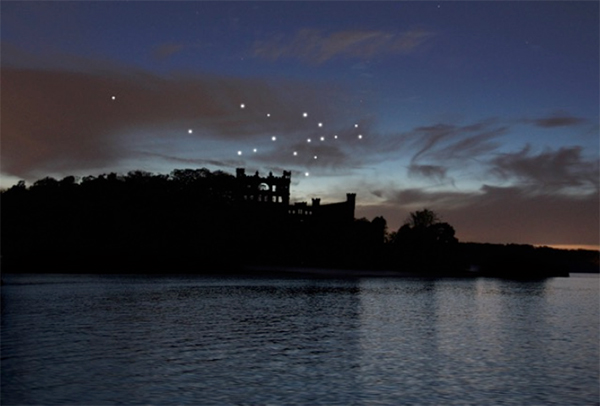
To end on a high note, the island is home for the next two hers to a beautiful art installation called Constellation by Melissa McGill.  Seventeen LED lights mounted on metal poles at various heights form a gorgeous constellation of stars over the island.  Look:


Annamaria Alfieri