Wednesday, April 3, 2013

Mystery Writing in the Third Grade


My grandsons' school invited me to lecture about mystery writing in the classrooms of Alexander and Nathaniel, shown here in their Halloween costumes from last October.

At this juncture, their third-grade writing syllabus calls for them and their classmates to try their hands at mystery stories.  One suggestion was that I talk about my process as a writer.  That's an easy thing for any writer to describe, but it didn't seem it would help the children at all with their own stories.  Of course, there is no lack of formulae for mystery writing; I could have taught them one of those.  But it didn't seem right to constrain their young minds with structures they might take as hard and fast rules.  I wanted to come up with something helpful to them in inventing out of their own imaginations. 

About a week before the gig, I woke up in the middle of the night, thinking about the six major questions.   A whole lot of ruminating in the wee hours yielded a plan that worked well in both in Alexanders class and in Nathaniel's a week later.

We started by defining what the kids thought a mystery was.  I wrote down their answers on the white board--a projection system that takes a bit of getting used to.  When any of the students shouted out a definition that contained one of the question wordswho, what, when, where, how and whyI put those words on a special list.  When we had most of them up there, the children filled in the missing ones.

Then, we talked about how a mystery story usually begins with giving away the answers to three or four of those questions.  But the writer withholds some of the answers.  I made a crude diagram.

........   .   .   .    .   .   .   

Did they know the story of Hansel and Gretel?  Sure, they did.  What did the brother and sister do to help someone trying to follow them?  Of course the kids knew that: a trail of breadcrumbs!  That's what mystery writers do, I told them.  They hold back the answers to two or three important questions, usually but NOT always Who and Why.  They start the story by dropping a whole pile of breadcrumbs and then lead the reader through the rest by dropping a new hint every once in a while.  And sometimes those hints are false ones. "Red herrings," a little girl with glasses and a boy with Harry Potter-ish black unruly hair shouted in unison.

We spent the rest of our time together inventing plots.  "Somebody think up a main character," I asked. 

"A cranky girl."

Somebody describe a bad guy.

A boy who actually looks like a hero but isnt.

Who is going to be our victim?

The girl's grandmother.

For ten minutes in a furious flurry of creative thinking, we invented plot after plot.  They never asked me where I get my ideas.  They were just brimming with them. 

 I don't know how the kids made out with the stories they went on to write for themselves.  The few beginnings  I saw showed a lot of promise. A couple were astonishingly sophisticated in how they opened.  One thing I know for sure: nothing I have ever read or heard as a student of the genre ever crystallized my thinking about how to plot a mystery as clearly as hanging out in the third grade.

 Annamaria Alfieri

Monday, April 1, 2013

Marilyn Meredith's Rocky Bluff Characters


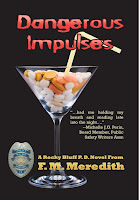
Our returning guest, F. M. Meredith, a/k/a Marilyn Meredith, writes two police procedural series. Dangerous Impulses is the ninth in her Rocky Bluff P.D. mysteries and Raging Water was the twelfth Tempe Crabtree, resident Deputy Sheriff of Bear Creek, in the mountains of California. Marilyn (I’ll just call her by her given name) describes her police procedurals as on the cosy side. Yet all the classic elements are present: convincing policemen performing as expected, an intriguing (even exotic) setting, and crackling-good story. Her procedurals are ‘exotic’ to me—a writer of NYPD procedurals–since set in small rural locales far from Big Cities. Rocky Bluff, the setting of Dangerous Impulses, is a fictional beach community between Ventura and Santa Barbara. Like the best of our genre, though—McBain’s 87th Precinct, Wambaugh’s LAPD—Marilyn uses a recurring ensemble of cops and locals so we settle in and feel at home while following their latest trials, public and private.

Robert Knightly


Because this is the last blog stop for my tour for Dangerous Impulses (#9 in the series) I asked for a suggestion as to what someone would like to know about the series. The answer was, "What inspired the characters?"

Officer Doug Milligan is the main character in the first book, Final Respects. In many ways he resembles my son-in-law who served 15 years in law-enforcement before losing his life in the line of duty. Not in looks of course, nor in the unhappy marriage, but they have similar attributes and definitely the same kind of love for the job. Anyone who has read any of this series knows life changes Officer Milligan matures and he becomes Detective Milligan.

Doug’s first wife’s description is the same as a neighbor of ours who no matter what she wore looked like a model. Fortunately, our neighbor had a much better personality.

Lt. Tom Gilbreath is the main character in Bad Tidings (second book) and I must confess he’s a dead ringer for a good friend who was not a police officer but our kids’ high school vice principal and truant officer. His wife in the book has many of the personality characteristics as my friend’s wife—but that’s where the resemblance ends.

And yes, I did fashion the most dreadful Cal Sylvester in Fringe Benefits after an obnoxious cop who lived in our neighborhood years ago. No, he didn’t figure out a plan to kill his wife, but he wasn’t a nice man.

Stacey Wilbur has a lead part, if there is such a thing in a book, in Smell of Death. She doesn’t look like anyone I know, but her strength and perseverance are based on two female police officers that I know. Despite her vow to not date anyone of the Rocky Bluff P.D. she becomes interested in Doug when she helps him on two cases.

No Sanctuary features two ministers, composites of pastors I’ve known over the years, and two churches—one is exactly like one I went to as a kid, the other similar to one I visited.

Rick Strickland plays a part in all of the books, a handsome womanizer who is a publicity hound—at least that’s how he starts out. Life change for him in the first book and he probably matures more than any character in the series—though he does have his shortcomings. I don’t really know anyone like him, but the publicity hound aspect came from a police officer my son-in-law told me about.

Gordon Butler debuts in Fringe Benefits. He’s not really like anyone I know, but he’s become a real person to me. Despite, or perhaps because of, being a by-the-book police officer, nothing ever turns out well for him and he ends up being the butt of many jokes. In No Bells, the love of his life turns out to be the main suspect in a murder case. He’s become a favorite among my female readers.

Abel Navarro has a big family and I’ve used his family’s dynamics in many side plots in various stories. When it came time for a new Sergeant to be chosen, he knew Felix Zachary would probably be the one—though it doesn’t work out that way. Both these men have personality components and family problems that I’ve witnessed in one way or another among my relatives (yep, I borrow from them too).

Though in most cases, the characters are not based on people I know, I’ve taken a bit here and there from the different officers and their families that I’ve known from the time we had many police families in our neighborhood. The police officers that I’ve met through my association with the Public Safety Writers Association have given me ideas too. (I met Robert Knightly at a PSWA conference—and no, none of the characters in my books are based on him.)

Once I’ve decided upon a character and started writing about him or her—no matter what inspired me, the character will morph into a different being who takes on a life of his or her own.

A bit about the latest in the series, Dangerous Impulses:

An attractive new-hire captivates Officer Gordon Butler, Officer Felix Zachary’s wife is befuddled by her new baby, Ryan and Barbara Strickland receive unsettling news, while the bloody murder of a mother and her son and an unidentified drug that sickens teenaged partiers jolts the Rocky Bluff P.D.

Contest:

The person who comments on the most blog posts on this tour may have a character named after him or her in the next Rocky Bluff P.D. crime novel or choose a book from the previous titles in the series.

Rocky Bluff P.D. Series:

Though each book in the Rocky Bluff P.D. series is written as a stand-alone, I know there are people who like to read a series in order. From the beginning to the end:

Final Respects
Bad Tidings
Fringe Benefits
Smell of Death
No Sanctuary
An Axe to Grind
Angel Lost
No Bells
Dangerous Impulses


Marilyn Meredith
http://fictionforyou.com/
http://marilynmeredith.blogspot.com/
On Facebook and Twitter as MarilynMeredith

Sunday, March 31, 2013

How I Became A Woman of Mystery

“Oh, you’re being such a snob!”

I am a snob, but I always hate it when people catch me at it.

The judgment came from my friend, Jean Griffith, who had just announced to me that she read only mysteries. I sniffed a bit and allowed as how I never read them.

“Well, try this,” she said, brandishing a copy of Cover Her Face by P.D. James as if it was a sword.

Coles House
Jean and I lived at Coles House, then a residence for young ladies in Center City Philadelphia, so I returned to my tiny room and read most of the night. It changed my life (and I still remember whodunnit). Though I had studied and learned to revere contemporary fiction, I couldn’t deny the pull of a book that boasted a beginning, a middle and an end. The characters were well drawn and actually did things (like kill people); they didn’t just sit around displaying their exquisite sensibilities.

So I became quite the little mystery addict. My substance of choice was cheap (when I started reading mysteries they were a mere $2.50) and Jean, like any good supplier, was full of sage advice (“Try Ngaio Marsh. The books are only $2.25 and the print is REALLY small!”)

James Ellroy
Jean and I went to the 1989 Bouchercon. James Ellroy signed my copy of The Big Nowhere (“Stephanie—To the wooooo of your sensuality”), kissed my hand and suggested we might spend the afternoon discussing his books. Alas, the 150 people behind me in the book signing line had other ideas.

While that was a cheap thrill, it was not nearly as important as my introduction to Robin Hathaway. (Jean worked with Bob, Robin’s husband). Robin was not yet published and was at Bouchercon to learn from those who were. On the last day of the conference Jean and I came home with Robin and feasted on cheese, crackers and wine which if you are having them with good friends constitute life’s most perfect meal.

Unfortunately, Jean died in 1997 around the time that Robin was published. Robin and I subsequently became frequent mystery conference roomies going to many Bouchercons and Malice Domestics. (or is that Malices Domestic?)

Somewhere along the way Robin and I discovered that we liked a lot of the noir writers. I still remember the first time I read Cornell Woolrich’s Waltz into Darkness. It made me feel cheap and dirty. I couldn’t wait to feel that way again. Then Robin discovered Noircon, a mystery conference designed to honor David Goodis and other noir writers. Who knew that moral turpitude and depravity could be hilarious? I still remember the early Friday morning panel on erotic elements in noir novels. There was a lively discussion of bestiality with the exchanges like this:

“What’s the big deal about bestiality?”

“The animal can’t consent.”

Robin wrote furiously and pushed a piece of paper in front of me.

I looked down. “They don’t have these kinds of discussions at Malice,” she had written.

Yes, I really miss Robin and am delighted to have a spot on this blog.

Friday, March 29, 2013

Children of Imagination

Shoo Boo
I had a weird dream last night. It all came of eating too many chocolate malt balls, playing too much Shoo Boo, and thinking too hard about the strange case of the four-year-old boy who was found all by himself in their apartment with his dead mother last week. Poor kid, he was naked except for one sneaker, starving and dehydrated. What struck me as odd about the story was that offers to adopt him were pouring in from all over the country. Massive numbers of offers. I said to Harold, don't these people realize how damaged the kid is? I wouldn't undertake to raise him without a master's degree in child psychology. Harold said, they admire him. The kid has a lot of grit. And people want children.

The Kettles' House
In my dream I was hiking in the mountains. I stopped at a house like the house where Ma and Pa Kettle used to live in the movies, cars up on blocks, chickens running around the yard. The lady of the house, a fat lady in a flowered house dress, pushed a baby carriage at me and said, "Here. Take them." Inside the carriage were a four-year-old boy and an infant girl. The boy smiled at me in a wise-acre way. I began to struggle down the hill with the carriage. "I hope Harold won't mind," I thought. It was dawning on me that these children were an enormous responsibility.

Suddenly I noticed that the baby was gone. "Where is your sister?" I said to the boy. He smiled. "I pushed her out." The poor little thing was lying back on the trail in her christening dress. I picked her up. Her skull was cracked. I put her over my shoulder to comfort her. Babies feel so good, even when you're worried about them.

Back at my own house at last, I found places for the children to take naps and tried to explain to Harold why I had undertaken to raise them for the next twenty years. The little boy turned into a fox terrier. He jumped up on the table and ate our lunch. The doorbell rang. I went to answer it. There stood Parnell Hall, smiling affably. He had forgotten my name.

And so it goes, as Kurt Vonnegut would say. Maybe it was a metaphor for my literary career. It's entirely possible that playing Shoo Boo is making me blind. I know the malt balls are making me fat. If you would like to play Shoo Boo, here's a link: http://www.by-art.com/bubbles/

Kate Gallison

Wednesday, March 27, 2013

Meet Jerome Coopersmith


The greatest joy, for me, of being an active member of MWA/NY is the people I meet.  Jerry is one of them.  He is one of our few dramatists.  He has a list of credits, which typed in an 8 pitch font, would be longer than your arm.  It includes a lot of radio, TV, and stage plays including the books for musicals.  Take a look here at his impressive credentials, just for Broadway:

http://broadwayworld.com/people/Jerome-Coopersmith/

I had to visit three websites to get even an inkling of the breath of his accomplishments.  And right now, rehearsals are on for a new one act mystery play--"Pipe Dream," which will have its premier at the National Liberal Club in London on May 16th, under the auspices of the Sherlock Holmes Society.  It's about a tough New York detective who is stumped by a crime and visits the Sherlock Holmes pub in London, where he is led to the solution by a renowned ghost from the past. 

Today Jerry regales us with the story of how he once wrote historical playlets for the budding medium of television.  

Annamaria Alfieri


In the days when television meant snowy pictures that you might improve by wrapping aluminum foil around your antenna, I had a job as an assistant to an early TV producer.  My job was to help him put on a quiz show in which viewers tried to stump a panel of brilliant teenagers on the subject of American history.  If you submitted a question that was used, and you stumped the wunderkinds, you won a set of Encyclopedia Americana – not a bad gift – 30 volumes with genuine leather bindings and gold imprint on the spines.   The trouble was that most of the questions sent in by the audience were not worth a damn, much less 30 volumes, so who do you think dreamed up the questions that were used?   We didn’t dare tell the sponsors or the TV station execs that Jasper LaRoche of Wilbur, Wisconsin and Pastor  Neumiller of Boise, Idaho were really Jerry Coopersmith of West 68th Street.  As a result, the floor of my office was littered with sets of encyclopedias still in their packing boxes.                                                                                                                

One day, I tried to persuade my boss to change the format of the show just a little.   I proposed, “Instead of asking questions allegedly from the viewing audience why don’t we put on a short dramatization of an historic event, and base the questions on that?” 

“You mean – with actors and costumes and everything?”

I nodded.

He loved the idea.  Then he asked something I hadn’t thought of.   
“Who’s going to write the dramatizations?”

My reply was not an act of courage.   I would have done anything to stop those  encyclopedias from taking over my office, but I honestly believed that the  playlets would make the show more entertaining.  In addition, I did have some experience in dramatic writing, but it was limited to a one-act play I had written in college with the collaboration of two other students.  My boss accepted that as a major credit, and starting the following week I was the author of one short teleplay per week based on American history. 

Although they were limited to one set and two actors to keep the cost down, they worked beautifully.  In a small TV studio we depicted moments aboard Columbus’ ship, on Jefferson’s estate, and in Benjamin Franklin’s home when he tried to dissuade his son from going to war on the side of the British.  We were able to get top-notch actors because Hollywood was in a slump at the time, and many of the movies’ finest were flocking to New York hoping to get their feet wet in the new medium.  
                                                              
Writing those playlets I learned how to create characters, not just for history plays, but for all sorts of dramas including mysteries that I would be writing in times to come.   And I learned that I enjoyed telling stories using only the actions and words of characters, rather than my own narrative skills.

There are two questions you must ask yourself if you hope to become a dramatic writer.  One, do you love it – to the extent that you don’t mind staying up nights to rewrite a scene, or a play if necessary.  Two, are you good at it – not just in your own opinion, but in the evaluation of others.  My response to both has been supported by the fact that I’ve been able to make a living for myself and my family as a writer in TV and theatre.            

Today, many years after “Americana Quiz”, I still run to an unfinished scene as often as I can to write the lines of dialogue that may be needed.   And I still enjoy it immensely.

Jerome Coopersmith