Florence is incomparable. No doubt about that.
But.
Taking nothing away from the greatest art treasury in the world, there are also great pleasures to be had in two small cities that are very nearby. My favorite thing about Bologna and Arezzo is that unlike the international tourist mecca that is Florence, these two seem one hundred percent Italian. Not that they are lacking in artistic wonders, to be sure, but their vibe is local, focused.
Bologna is red. From the brick and paint on its stately buildings, to the liberality of its democratic politics, to the mouthwatering tomato-y richness of its Tagliatelle alla Bolognese. Only half an hour by fast train from Florence one finds delights for the eye, the taste buds, the soul. In the heart of the city are two adjoining piazzas often thronged with students at its famous university—along with Paris, one of the two oldest in Europe. In the center of Piazza del Nettuno, is a fountain graced with a wonderful muscular Neptune by Giambologna.
On this recent visit, we were privileged to attend an opening at our friend Tiziana Sassoli’s Galleria Fondantico. Tiziana is a world-class expert in the paintings of her region of Italy from the fourteenth to the eighteenth century. For the launch of her latest exhibition, she recreated a still life. Amazing.
Take a look at the full exhibition by visiting the gallery at www.seleart.com/fondantico. Don’t miss the painting I wanted to take home (if only!), Donato Creti’s splendid Minerva. When you get to the website click on “Galleria” to see the show.
Arezzo is a totally different sort of town: as peaceful as Bologna is bustling, as Tuscan restrained as Bologna is voluptuous. In the church of San Francesco is one of the greatest masterpieces of the Renaissance: Piero della Francesca’s “Legend of the True Cross.” Here is a self-portrait he placed in one of the panels of the fresco. Read the legend in Piero’s pictures at http://www.casasantapia.com/art/pierodellafrancesca2.htm.
Arezzo has a long and glorious artistic and literary history that includes Guido of Arezzo who invented the system of musical notation, Petrarch (who was born there in 1304), and the painter and art historian Giorgio Vasari. The modern-day genius Roberto Benigni the writer/director of “Life is Beautiful” is also an Aretine and you may recognize his native city’s Piazza Grande from the scenes of the movie shot there.
On the train back to Florence from Arezzo, I got to thinking about going home to New York this coming Saturday. As we sped through the Tuscan countryside of acres of vineyards and olive groves, villas surrounded by midnight green cypresses, and hills topped by castles and monasteries, I wondered how I could leave all this beauty. Nor can I stay here and do without my dear ones in New York any longer. I have long said that when I am in Italy, the people here consider me American. When I am in the States, people think of me as Italian. Whether I am here or there, a part of me is far away from home.
Showing posts with label Florence. Show all posts
Wednesday, October 26, 2011
Wednesday, October 19, 2011
Adoring David in Florence
Caveat: Some of you may know that I am married to a man named David. “City of Silver” is dedicated to him. But this is not about my love for my husband.
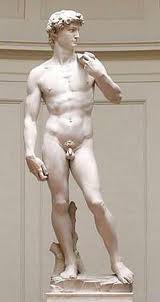
Michelangelo’s David is one of the most iconic works of art on the planet: so pervasive an image that a person could be forgiven for thinking it trite at this point. Forgiven, but VERY wrong. True, tourists here can buy pictures of it on postcards and reproduced in statuettes of thirty different sizes. There are Davids on jewelry boxes, aprons, pens, key chains, refrigerator magnets, tissues, change purses, and boxer shorts. (I leave it to your imagination to work out which part of his anatomy appears on men’s underclothing.) Want a David umbrella or tote bag? No problem.
Yes, there is all that.
But then in the Accademia stands the original whose presence inspires awe and worship. Its perfection defies description. The ideal of human being at a moment in an archetypal story. The sling over his left shoulder, the rock in his right hand, he contemplates facing the monster Goliath. He is Everyman (and every woman) who must battle an insurmountable foe.
Michelangelo wrote the whole story in marble. The position of David’s limbs, the tension in his hands and neck, and especially his face. Fear. Determination. Strategizing. You can read his mind in those eyes, the furrows in his forehead, the set of his jaw.
I looked in the museum bookstore for a postcard of that face and discovered another reason to be amazed. There were several. Depending on the camera angle, David’s expression emphasizes one emotion or another. In some pictures, he looks more afraid, some more determined, the profile is almost serene. These are photos of a stone man. His expression does not change, but he shows you different aspects of himself as you move around him. How did Michelangelo do that?
We marvel at David because as we view him he comes alive.
Annamaria Alfieri
Michelangelo’s David is one of the most iconic works of art on the planet: so pervasive an image that a person could be forgiven for thinking it trite at this point. Forgiven, but VERY wrong. True, tourists here can buy pictures of it on postcards and reproduced in statuettes of thirty different sizes. There are Davids on jewelry boxes, aprons, pens, key chains, refrigerator magnets, tissues, change purses, and boxer shorts. (I leave it to your imagination to work out which part of his anatomy appears on men’s underclothing.) Want a David umbrella or tote bag? No problem.
But then in the Accademia stands the original whose presence inspires awe and worship. Its perfection defies description. The ideal of human being at a moment in an archetypal story. The sling over his left shoulder, the rock in his right hand, he contemplates facing the monster Goliath. He is Everyman (and every woman) who must battle an insurmountable foe.
Michelangelo wrote the whole story in marble. The position of David’s limbs, the tension in his hands and neck, and especially his face. Fear. Determination. Strategizing. You can read his mind in those eyes, the furrows in his forehead, the set of his jaw.
I looked in the museum bookstore for a postcard of that face and discovered another reason to be amazed. There were several. Depending on the camera angle, David’s expression emphasizes one emotion or another. In some pictures, he looks more afraid, some more determined, the profile is almost serene. These are photos of a stone man. His expression does not change, but he shows you different aspects of himself as you move around him. How did Michelangelo do that?
We marvel at David because as we view him he comes alive.
Annamaria Alfieri
Subscribe to:
Posts (Atom)