Showing posts with label Writer's life. Show all posts

Thursday, August 29, 2013

Right Now, Write Now…and Cook Dinner Too

I got an idea the other day, out of the blue. That’s the way they come. One minute you’re trying to get to your exit across three lanes of speeding traffic because that’s how New Jersey highway engineers thought it should be done, and the next, you know how your heroine will catch the killer.

When I got home, I was inspired. I had to, had to sit down and write. But it was my turn to cook dinner and I hadn't been to the store. I was saved because my husband, David, is a writer, too, and he said, sure go on, go write. And I did. But later, I began to think about what a writer does when she comes home inspired but has hungry kids waiting and no one to cook for them. Put off writing for a couple of hours? Or order a pizza stuffed with something only chemically related to real cheese?

I shared this thought with David while slurping down my second helping of his vegetable soup, made magically with whatever he'd found in the crisper and pantry. I asked whether it would be possible for a writer to cook a homemade meal that kids would eat and be out of the kitchen in, say, thirty minutes and headed for the computer? Here, my darlings, mommy cooked real food for you; now I’m taking a plate upstairs, so put on a movie and don’t bother me.

I said, “Not 30 minutes in TV-cooking-show time, where the prep staff cuts everything up while the host is getting hair and eyeliner. I mean 30 minutes in real-person time.”

He said, “Would this include actually reading the recipe first? And getting your equipment together?”

Right. Cooking-show and cookbook estimates never take that into account either.

I said, “What could you give me?”

He leaned over and wiped some soup off my chin. “Thirty-five, forty at the outside.”

And he did it. Twice.

The two recipes he adapted (and appear at the end of this blog) are hearty one-dish meals, with few utensils and simple instructions, and have ingredients relatively easy to find. Most of the ingredients also have a long shelf life and so could be easily on hand in pantry or freezer for the next inspiration emergency. Even the greens and the thyme can keep well for quite awhile in the refrigerator.

If your kids are ravenous teens, hand them a pint of cherry tomatoes and a loaf of bread, too. Tell them to wash the first and toast the second. Welcome to writer side dishes, kid!


Here's the farfalle. And no, I didn't take this picture. I took a picture of a picture. You learn fast how much work it is to make real food look as good as it tastes in a photo. This is from a Martha Stewart cookbook called Fresh Flavor Fast. Good book. But try saying that title three times fast.


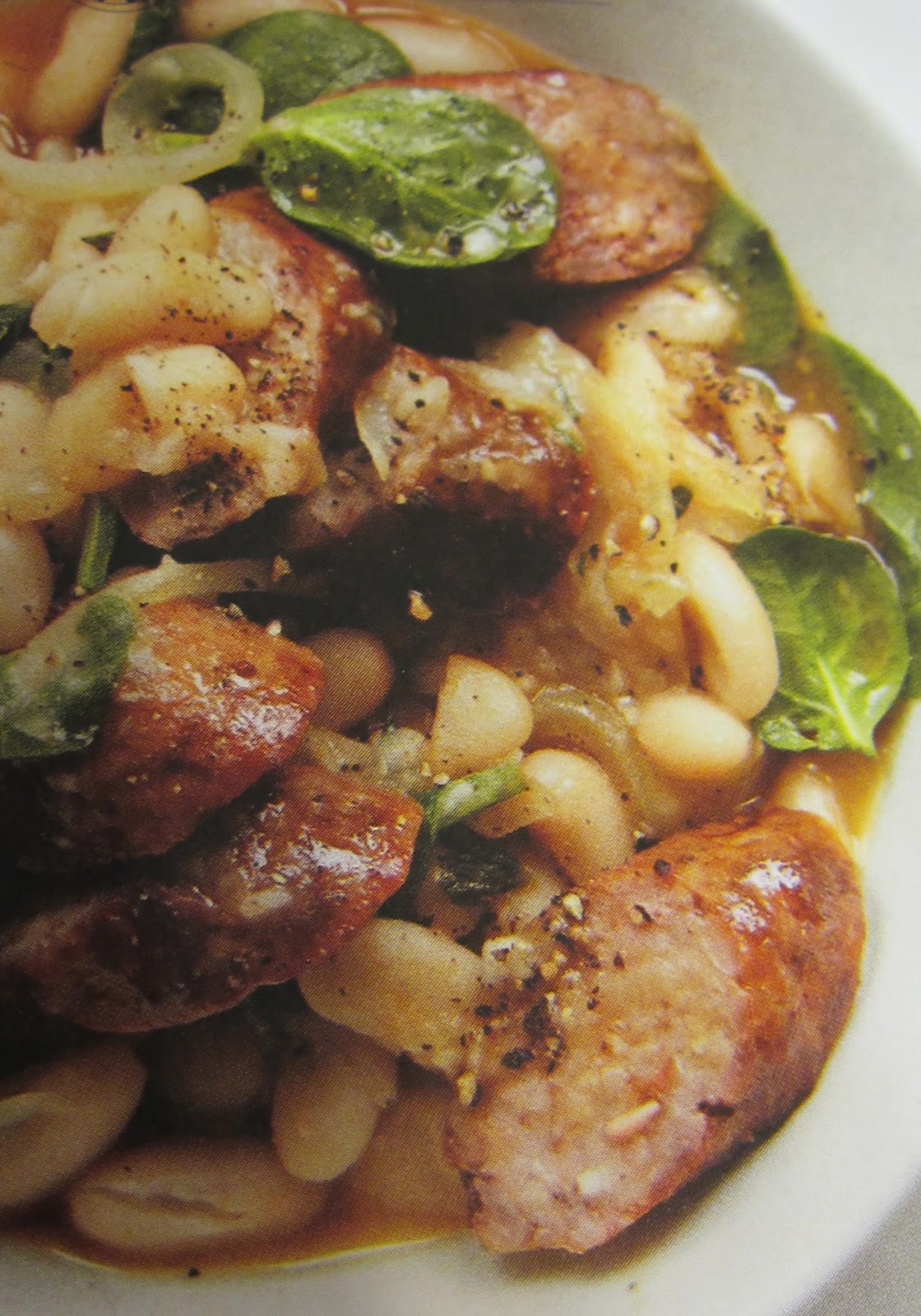
The chorizo shot is also grabbed from its source, the February 2013 Bon Appetit. 

My husband, David F. Nighbert, has begun migrating his backlist to e-books on Kindle and Nook. The mysteries (starred Kirkus reviews) Strikezone, Squeezeplay & Shutout are up now. And two SF novels, Timelapse & Clouds of Magellan, will be available soon. I highly recommend all!


This picture of us was taken by friend photog Mariann Moery as guests were arriving for the launch party for Death in Her Face at Mysterious Bookshop in Manhattan last fall. (If you look closely, you can spot Annamaria headed for the bar just beyond the man with the green bag strap on his shoulder to the left.)

We tried to create the recipes below as links to printable versions, but it's beyond the reliable skill of this blog tool (or maybe this blogger). But a simple cut and paste into Word will do the trick for you.  

Sheila York


Farfalle with Arugula and White Beans

Ingredients
Utensils
Coarse (kosher) salt and freshly ground pepper
Dutch oven (with lid) big enough for at least 5 qts water
12 oz farfalle (bow-tie) pasta (about 6 cups dry)
Chef’s knife & cutting board
4 Tbsp unsalted butter, cut into 1-Tbsp slices
Colander
4 small to medium garlic cloves, peeled and thinly sliced
Small skillet
1 pound baby arugula
Small plate to cool walnuts
1 can (15.5 oz) cannellini beans, drained and rinsed
Wooden cooking spoon
1/3 cup walnut pieces, toasted, for garnish
[Keep toasted walnut pieces on hand.
They’re nice additions to simple salads]
Measuring cup with pouring lip

Gather all your ingredients and utensils before starting your food prep.
1.
Start bringing 5 quarts of water to a boil over high heat in large covered Dutch oven. (Pasta is happier if it has plenty of water to swim in.) This is what takes time, so put the pot on your strongest-heat burner and keep it covered till water boils.
2.
While waiting, do your ingredient prep:
Peel and slice garlic; rinse and drain beans in colander; cut butter using the 1 Tbsp markers on the wrapping; chop walnuts into pieces if they didn’t come that way.
3.
Toast walnuts. Heat a small heavy skillet over medium heat for a minute. Add walnut pieces. Shake the skillet occasionally to keep walnuts from burning. After 2-3 minutes, transfer walnuts to a plate to cool.
4.
When water boils, add a generous amount of salt (about 4 Tbsp) and the pasta. Bring water back to a boil (cover the pot to make this happen faster). Cook pasta, pot uncovered, stirring occasionally to make sure pasta doesn’t stick together or to the bottom. Cook according to the timing on the package till it is al dente. (You’ll have about 10 mins here to get out your plates and flatware, and finish any ingredient prep)
When pasta is done, reserve ½ cup of the pasta water and set it aside.
Then drain pasta; leave in colander.
5.
In the now-empty Dutch oven, heat 1 Tbsp of the butter over medium heat, then add the garlic. Cook, stirring, 1-2 mins. Do not brown the garlic.
6.
Add the arugula, handfuls at a time, and stir/toss just till wilted, a couple of minutes.
7.
Add beans, pasta and remaining 3 Tbsp of butter; season with salt and pepper.
8.
Heat, tossing, till butter is melted and beans and pasta are warmed through, about 1 minute. While doing this, add enough of the pasta water slowly to create a thin sauce. You will not need all the water.
9.
Check seasoning; adjust as necessary.
Serve in shallow bowls and garnish with the walnuts.

Adapted from Fresh Flavor Fast, copyright 2010 Martha Stewart Living Omnimedia


Chorizo and White Bean Stew

Ingredients
Utensils
2 Tbsp olive oil, divided
[‘divided’ means you won’t use it all at once]
Large Dutch oven
1 lb. chorizo (buy it precooked). You can use other spicy, precooked sausages (Italian, andouille, etc.) 
Wooden cooking spoon
1 large onion, thinly sliced
Tongs to turn sausage & remove thyme
4 garlic cloves, peeled and finely chopped
Colander
1 sprig fresh thyme. [How much is a ‘sprig’, you ask? The equivalent of three 3-inch leafy pieces works for us]
Chef’s knife & cutting board
2 cans (each 15.5 oz) cannellini beans, rinsed, drained
Small plate
2 cups low-sodium chicken broth
Measuring cup with pouring lip
5 oz baby spinach (about 10 cups).
Measuring spoons
Kosher salt, freshly ground pepper

Smoked paprika (optional)


Gather all your ingredients and utensils before starting your food prep.
1.
Heat 1 Tbsp of oil in large Dutch oven over medium heat. Add precooked sausage and brown, turning occasionally, 5-8 minutes.
2.
While sausage browns, slice onion; chop garlic; rinse/drain beans in colander.
3.
Transfer sausage to a plate. Leave fat from sausage-browning in the pan. Still over medium heat, add remaining 1 Tbsp oil to same Dutch oven (2 Tbsp might be necessary if the sausage did not leave much fat). When oil/fat is heated, add onion slices, garlic and thyme sprig. Cook, stirring occasionally, till onion is softened, about 5 minutes.
4.
Add beans and broth, and cook 8-10 minutes, crushing a few of the beans with the back of a wooden spoon to slightly thicken the sauce. While this is cooking, slice the chorizo and collect plates and flatware.
5.
Season stew with salt and pepper
6.
Add spinach in handfuls and cook till just wilted, about 2 minutes.
7.
Fold chorizo into the stew; Add a bit of water to thin, if desired.
8.
Remove thyme sprig (if you can find it). Divide stew into bowls, sprinkle with the paprika if you choose, and serve

Adapted from Bon Appetit magazine, February 2013. The original recipe calls for fresh sausage, which would take longer to cook. We’ve been able to find spicy, precooked sausage at our regular grocery store.


Thursday, July 25, 2013

The Writer Prepares (A Nice, Cool Cocktail)


It’s been a brutal summer. Normally, my part of the Northeast — northern New Jersey — rarely gets above the low-80s, and then only for a few weeks late in the season. When I moved up here from Houston years ago, I thought I’d left behind the feeling of breathing through a hot, wet blanket — and the palmetto bugs the size of container ships. The bugs didn’t follow me north, but we've had mid-90s heat and smothering humidity since late June. 


So what does a writer do when she doesn’t have air conditioning in her office? 

What any self-respecting writer does: She drinks.

Okay, not while working. I’ve never believed all those stories about storied writers who were blasted while turning out top-notch prose. So many of them carry the implication that drinking somehow made the writing better, rather than the writing being excellent despite the alcoholism. I know for damned sure alcohol does not improve my writing.

A refreshing summer cocktail, however, can be the perfect end to a sweltering workday. And as we head into August, I thought I’d share a few of my favorites. Among the recipes I had available, I looked for three important characteristics: They had to be intended to be iced; relatively easy to make; and have flavor that popped. No bland or cloying drinks for us. Cool, easy, bracing, refreshing, those are the cocktails for a long, slow, sultry summer evening.

For my final choices, I consulted my über-cool neighbors across the street, who are cocktail enthusiasts (and one is a forensic anthropologist, so I have him on speed-dial for two reasons). They are the ones who introduced me to the work of Tom Richter, a bartender at The Beagle in New York City. My new personal favorite summer cocktail (Saints & Sinners) was passed along from him. [Tom also sells his own tasty tonic for a new twist on that summer staple, the gin & tonic, called Tomr’s Tonic.]   

Before we get started, a note on measurement. Most shot glasses are 2 oz (not 1 oz). You can test that by filling your shot glass with water and pouring the water into a 1/4 measuring cup. If the water fills the cup, it's 2 oz. 

Here are the cocktails my friends and I settled on:

The Dark & Stormy

A writer just has to start here, with that name. This is a Bermudan cocktail created in the early 1900s. Relax and stop worrying about that opening sentence for your book.


Pour over ice in a chilled glass:
3 oz chilled ginger beer (or more if you want to reduce the alcohol ratio)
1 oz dark rum
Stir; garnish with a slice of lime
[Ginger beer is non-alcoholic and available in larger liquor stores and supermarkets.]

The Negroni

Created in the days of silent films (this one's for Kate), this is extra easy to make for more than one person: The proportions are 1-1-1. The shaker also provides a bit of theater if you make this for guests.


The basic recipe for one cocktail (add more ice if you're making a shaker-full):

Place a half-dozen ice cubes in a cocktail shaker. Add:
1 oz good gin
1 oz Campari
1 oz sweet vermouth

Make sure the shaker lid is secure and shake until your hands get icy cold. When they start to hurt, that’s when it’s ready.

Strain into a chilled martini or highball glass (I like mine in a highball glass with ice, but a martini glass — or as in the picture, an old-fashioned champagne "coupe" — makes a nice presentation). Garnish with a twist of lemon or orange. If making a twist is too much trouble (and it can be), forget the garnish. 

Note: You could also muddle (crush) some slices of peeled orange in the shaker before adding the ice for a bit of extra flavor and some light (tasty) pulp in the drink. And a rationalization that you're drinking healthy. 

Saints & Sinners (or Saint & Cynar)

This delectable concoction requires sparkling wine (which won’t keep long in the fridge after opening), so it’s probably best for when you have friends over.


To a tall mixing glass (or a pitcher) with ice cubes, add:

2 oz St. Germaine (which is an elderflower liqueur)
1 oz Cynar
4 oz chilled dry sparkling wine (I recommend Freixenet Cordon Negro Brut; it’s inexpensive and tastes just fine)

Stir to chill well; pour only the liquid into a chilled highball glass with ice cubes in it; garnish with orange slice or orange twist.

Safety Note: Never use a shaker for this drink. We’re talking about a carbonated beverage here, which can explode if shaken in a closed container. (Think about what happens when you shake a carbonated soft drink.)


Enjoy!  Have a refreshing August!

Sheila York


Thursday, June 27, 2013

My Fungi-side

Ah, finally done. 

I've just wrapped up two intense weeks tackling the edited version of the next Lauren Atwill mystery, No Broken Hearts (coming in late spring 2014). So I'll have a social life again, as much I ever have one. As soon as I returned the manuscript, David and I threw a BBQ for a couple of dozen friends. The simple pleasure of eating off a paper plate and not a keyboard. 

When you're up against the return-the-manuscript deadline, you don't get many breaks. But it's important to squeeze some in. They refresh your imagination. 

But sometimes they don't make you feel better. Case in point: I was cruising an entertaining editor’s blog and on her site is a picture of her office. 

I started feeling a bit grumpy, because I always want my office to look like this:


Editor A. Victoria Mixon in the office I dream about


But instead, it looks like this:


Note that I do have the 4 basic food groups for writers (clockwise from far left): Water (glass), coffee (cup), wine (bottle), takeout (box). 

I kept this shot dark on purpose. The dust doesn't like the light.

As I snapped this, I began to think about pictures I've taken that looked (lots) better. And about how most of those pictures are yet to be organized. 


As you can see, organization is not my strong suit. 

So, once I'd sent the edited version of No Broken Hearts back, I began a search through my folders (and folders) of pictures from past vacations, and came across shots I’d taken when David and I hiked in the Finger Lakes region in upstate New York

Just looking at them, I felt better. I was outdoors again, not stuck in the office for weeks listening to a neighbor's constantly yapping dog while trying to rework dialog. [My neighbor believes the dog protects her, barking at intruders. But if it barks all the time, how is that protection?]

As I said, I felt better. I love hiking, and over the last couple of years have rarely got to do it, with the demands of the other career and writing two books. 

Okay, this is sort of embarrassing — but we're all friends here. I enjoy taking pictures of, well, fungi. Not the kind that sprouts under your camellias after a week of rain, and looks like a nasty aspic. The kind that surprises with shape, color and its artistic harmony with its surroundings. And in the Finger Lakes, just off the woodland paths, you can see the most wonderful examples. And no one disturbs you. In fact, I've found that when other hikers realize I'm photographing fungi, they move on pretty fast.  Here are just a few shots I found in my folders.


Maybe I should get these printed/framed. 

Just to the left of the pizza box, I have nice blank strip of wall.

I don't know why I'm so attracted to fungi.

Maybe because writers often feel as if they're stuck in the dark among detritus.

At any rate, it might explain the condition of my office.


Sheila York


Tuesday, May 14, 2013

Maybe There's a Lesson Here


I’m going to miss Smash. In spite of itself.

Writers need a break from the reality of their writing lives. As most any writer will tell you, when you commit to writing, you don’t get many diversions. Deadlines (self- and publisher-imposed), your family, the chores, and the other career (the one with the 401k and health insurance) don’t leave much room for other activities. You don't get to read for pleasure or see friends as much as you’d like. You go out less; you entertain less. Sometimes, it feels like you don’t do much except work and the laundry.

At times like that, I need a reboot. I need to shut down the creative part of my brain for an hour. When I start it up again, whatever froze my imagination and enthusiasm has usually disappeared. In addition, my eyes spend so much time going back and forth across my computer screen or printout that, if the reboot diversion also gives me a chance to roll my eyes for a while, so much the better.

And Smash was a worthy diversion on both counts. In the beginning I watched in sofa-lolling relaxation an undemanding melodrama with excellent singing, and then I watched – my eyes circling my sockets – plot twists so contorted that I just had to see what the next bizarre pretzel-turn would be. Which isn't necessarily all that easy with your eyes rolling around in your head.

Smash was (actually still is, for the rest of the month) about getting a musical to Broadway. Maybe I should have been warned when a series has enough, dare I say, hubris to give itself a title like Smash. And to think there was much left to be said about Marilyn Monroe.

But hey, I wasn't looking for art. And as a bonus, I got to hear some terrific Broadway voices, performers who know how to interpret a song, and don’t think that as-loud-as-I-can-belt and as-long-as-I-can-hold-this-note are the hallmarks of singing. And I got to see some pretty fair dancing for a TV series (at least in the first season).

I was charmed by Christian Borle. In awe of Megan Hilty. Eager to see what Jack Davenport would get up to next. And I was certain Anjelica Huston’s facial muscles would eventually move.

And I could pair the show with a wonderful blog by Broadway actress/dancer Sharon Wheatley called SMASH: Fact or Fiction, a valentine to Broadway, full of fascinating tidbits and insight about what it’s really like to create a show on the Great White Way. And, unlike so many entertainment bloggers, Sharon doesn't seem to have a snarky bone in her body. But eventually, the parade of implausible plot points and absurd motivations forced even Ms. Wheatley to give up on Smash

Sigh.

Maybe Smash never really had a chance. Ultimately, its premise was deeply flawed: that there could be a believable competition for the role of Marilyn between the characters of Karen and Ivy. It says something about network-TV desperation, the lure of cross-marketing and the demands of “media-ready” casting that American Idol runner-up Katherine McPhee (as Karen) was thrown mercilessly into the ring with Broadway vet Hilty (as Ivy). Yikes, what alternative universe have I wandered into that this fight could be fair?!

Even if one accepted the premise that a woman with no Broadway experience who looked and sounded nothing like Marilyn could be a contender, the show swung off the rails a few times in season one. Then the swinging turned to careening in season two. Karen quit the lead (the lead!) in the Broadway show Bombshell – a role in which she was called “brilliant” by other characters though the TV audience was never granted the privilege of seeing these on-stage moments – for a role in a black-box theater downtown because…  Oh, it doesn’t matter, it made no sense. The renowned Broadway director Derek (Davenport) leaves Bombshell, too, in a huff, then agrees to direct the downtown show, which isn't really finished and was created by a couple of guys who've never had a thing produced before. And Bombshell’s composer (Borle) is suddenly, with no experience, Bombshell’s director. Whaa??

And although I could have gone on rebooting my brain with Smash, NBC has pulled the plug.

What can I salvage? As with any failed relationship, one asks: Is there at least a lesson to be learned here? Can I find any bits of wisdom to pass on to, say, a reader of this blog who’s an aspiring writer? One working on a mystery novel and not, say, a network TV show?

No square pegs in round holes. In mystery novels, you don’t get cut much slack for these. Your characters aren't allowed to go off and do something that makes no sense because, you know, you need them to. Your protag can’t just decide to investigate a crime because, well, she found a body and you need her to be an amateur sleuth; and she can't do dumb things because you need her in peril. She can't go into the house when she finds the front door open; continue into the deserted parking garage even though she thinks she’s being followed; or agree to meet a mysterious informant in a place not flooded with light and witnesses. When your writing starts to feel like hammering, it’s time to stop, rail at the wall for an hour, then admit your needs aren't really important here. What does your character need? A better motive.

Obnoxious does not equal a character readers love to hate. Smash didn't learn its lesson in season one with the character of Ellis Boyd, the uber-obnoxious assistant. They doubled down in season two by making uber-obnoxious a main character, Jimmy Collins (played by Jerome Jordan exactly as the writers/producers/directors must have wanted him to play it, because he’s capable of nuance and charm). They chose to make Jimmy not only a ^%#*, but a callow ^%#*. And callow and ^%#* are pretty much impossible to make compelling. They made poor Karen his doormat, so maybe we were supposed to hate him while at the same time intuit that there was a good man underneath all that because, uh, Karen fell for him and he's cute. Doesn't that count? Not in mystery novels. Not unless you want the reader to throw your book across the room. Readers see people who are uninspiring, unintriguing and unbearable every day. They probably work for one. They don’t want to read about them when they get home.

And so Smash will be gone soon. What will I do for a reboot? Where can I find another show that will render me alternatively brain flat-lined and yelping at the TV?

I mean, other than Castle. (My devotion to Nathan Fillion is not unmotivated. Since Firefly, a woman is justified in following him practically anywhere.)

Other suggestions for reboot candidates are welcome.

Sheila York

Tuesday, December 11, 2012

Not How I Imagined It

Today we welcome guest blogger Joyce Tremel! Joyce is a former employee of a suburban Pittsburgh police department with a second degree black belt in Taekwondo. A member of Pennwriter's and a former Vice-President of the Mary Roberts Rinehart chapter of Sisters in Crime, she has written short stories for Mysterical-E magazine and non-fiction articles for The Pennsylvania Chiefs of Police magazine, the Pittsburgh Post-Gazette, the Penn Writer, and the Sisters in Crime publication Breaking & Entering. She is about to find a home for her first full-length crime novel. Look for her at www.joycetremel.com and twitter.com/JoyceTremel.


When Kate mentioned that yinz guys (as we say in Pittsburgh) were looking for guests to write on The Writing Life, I volunteered. But when I got to thinking about my writing life, I realized it’s nothing like I imagined it would be. There’s no writing garret, no maid, no cook, no multi-million dollar book deals… But I’ll take it anyway. I mean, really. In what other job can you wear pajamas all day if you feel like it?

I don’t think there is a typical writer’s life (other than working in PJs). For the last eight months or so, my days have consisted of wrangling contractors, making sure they’re getting the work done, reading up on septic systems, wells, and the best way to clean log walls. I’ve become an expert at installing and grouting bathroom tiles. Yeah. We’re building. And no, I’m not coming over to remodel your bathroom. In addition to the cabin stuff, I still have our “real” house to keep up with, although I’ll admit it’s not as clean as I’d like it to be. (I may be the only person in the world who polishes the outside of their washer and dryer.) This is where that maid in the previous paragraph would come in handy—except I’d probably want to clean before she came.

Then there’s Christmas shopping. And decorating. I don’t even want to think about baking this year. In the midst of all this, I still manage to get some writing done.

When I started this writing thing, I never realized how long it would take to even get close to having a published book. Although I’ve been writing off and on since I was a kid, I only got serious about it maybe twenty years ago. I wrote a really horrible story that read like Nancy Drew meets the Hardy Boys. I had no idea what I was doing. Point of view was all over the place, the characters were clichéd, you name it—I did it wrong. Fortunately, no copies of this travesty exist. I even destroyed the 3 ½ floppy discs on the off-chance that someone somewhere still had a computer that had a disc drive.

To make what could be a very long story short, I kept learning and writing. I’m on my third (and I hope, final!) agent and have a book on submission now. Fingers, toes, and whatever are crossed. I’m working on the next book in the series and also planning some other ideas just in case.

One thing all writers have in common: this writing life is unpredictable.

Joyce Tremel

Tuesday, November 13, 2012

The Day Job

Today we give you Alan Gordon whose books have made be laugh out loud and kept me riveted with their suspense.  Alan is a fellow historical mystery writer who is kind as well as immensely entertaining. He is the author of several mysteries the first of which is based on the characters from Shakespeare's Twelfth Night.   He lives in New York City and is a lawyer with the Legal Aid Society.  Here he is to tell you about the balance between his two lives.

Annamaria Alfieri

 There are writers who make a full-time living from writing. Then there are the rest of us. There are those who grab temp jobs and wait on tables and tend bar so that they can devote as much free time as possible to the next great work, and there are those of us who have a full-time career and write on the side.

I am a public defender with the Legal Aid Society in New York City. I’ve been doing it since 1984. And I write on the side. My first published story came out in 1991, my first mystery novel in 1999. I’m now up to eight published mystery novels and fifteen published stories scattered across different genres. [Then there are the musicals, but that’s another story entirely.]

Now, my output is dwarfed by quite a few people, but those people don’t handle seven to eight hundred criminal cases every year. And the question I most often get from my two worlds is how do I manage to do both? Followed up by, are you crazy? 

I would like to answer the questions in reverse order. Yes to the second. Writing is a compulsion. An addiction. It triggers endorphins and puts me into my happy place. When I approach the end of writing a novel, I tend to slow down, reluctant to leave the world I have created, to let go of the characters running around inside my head, doing such interesting and occasionally homicidal things to each other. When I have finished a project, I invariably experience something akin to post-partum depression, which can be cured by launching into the next project.

As for the how -- this is where the compulsiveness comes in handy. I try to write every day. The time of day has varied, usually according to my son’s sleeping and school hours. When he was small, I would write around nine at night. There was a sweet time when he was three when he insisted on going to sleep on the living room sofa while I typed away at my computer desk. I would pause when his breathing became regular and carry him to his bed, then come back and write until I was too tired. When he got older, he had to be out the door before 7:30 in the morning, and I had that hour to myself. In an hour, I could get two pages written. And nine months later, a book was born.

The day job is also conducive to research. Courts are inefficient. You spend hours sitting and waiting for a case to be called. While the hubbub does not let me get into a creative zone, it doesn’t prevent me from bringing along a book to read [say, a history of the vertical water-wheel, and yes, I own one], and a notebook to record facts, thoughts, and inspirations.

The other lawyers have come to tolerate these eccentricities, and respect, even envy, what I do. Scratch a lawyer, and you’ll often find a writer wannabe. [Actually, scratch a lawyer and he’ll sue your ass, so don’t do it.] There are a surprising number of lawyer/mystery authors. Most of them write about heroic mystery-solving lawyers.

I don’t write about lawyers, for the most part, and this is why I am able to do both. Writing, for me, is as much of an escape from the stresses of my daily life as reading is. As long as I have that happy, endorphin-ridden part of my brain to escape to, I can greet the dreck of the day job with equanimity. And the day job, which has its own spiritual rewards, also subsidizes the writing career. Each part of my life is unbalanced by itself, but together, they produce balance. A precarious balance, but balance nonetheless.

Would I quit the day job if the writing income suddenly took off? I honestly don’t know. My second published mystery, Jester Leaps In, was written during my only sabbatical from Legal Aid, which coincided with my wife going back to full-time work. I wrote six hours a day, picked up my son at the school bus stop, coached his Little League team, and finished the book in four months. It was one of the most enjoyable periods of my life. But I missed the camaraderie of my colleagues and the daily challenges of criminal law.