Monday, July 8, 2013

How I Became a Crime Writer, or, What I Did on my Summer Vacations

I met Dennis McFadden five years ago when I joined his fiction writers group here in Albany. He was the dean among a talented bunch. He had been getting his stories published in prestigious literary journals. I noted that he had crimes occurring in his stories; their pace reminded me of the atmospheric style of Louise Penny. After I dropped out to write Memoir (a special kind of fiction), Dennis's recessive crime writer's gene tunneled up (stories in 'Hitchcock' and 'Queen' and appearances in Best American Mystery Stories twice).

Robert Knightly


I must have been meant to be a writer. According to my mother, I was three years old when I looked through the bus window at a busy Washington, D.C., sidewalk and said, “Look at all the pedestrians.” Even then I was a phonetic exhibitionist.

It must have been meant to be, because my upbringing wasn’t much of a factor. Blue collar all the way. There weren’t many books around the house. Nobody in the family had gone to college. Dad told a few bad jokes when he was drunk, but no bedtime stories. I remember getting my hands on some Hardy Boys books (crime novels, now that you mention it), and when I was 15, I picked up a paperback called Boy With a Gun. It was, coincidentally, about a 15-year-old boy. It takes place during the Hungarian uprising, and the kid’s father and brother are killed, he ends up fighting in the revolution, and he and this 15-year-old girl are crazy about each other, but the end left me hanging. The kid was still fighting. The war wasn’t over. He and the girl (with whom I too was in love by then) still weren’t together. What happened? What the hell happened? I had to know.

So I wrote to the author, James Dean Sanderson, and asked him, and he actually wrote back! I tore open the envelope, about to have all my questions answered, all the mysteries revealed. But he didn’t tell me a damn thing. He was flattered, he said, that the book had affected me that way. He suggested I write an ending. I should write the damn ending! I should talk to my English teacher—I might even be able to earn credit for it.

The bastard.

Maybe that planted a seed, I don’t know, but I still never entertained writing, not seriously, until my senior year, when my English teacher spotted my “talent,” and singled me out for high and frequent praise. His name was MacBeth. That’s right. MacBeth.

Bruce MacBeth maybe, but MacBeth nevertheless.

How could I then not go on to college and major in English? I became known as a writer, publishing a couple of stories in the old “lit mag.” I was on my way. Then a funny thing happened. I took 10 or 15 years off after college to drink and party before I finally got around to writing again. My third book was pretty good, good enough to get me an honest-to-God New York City literary agent. But alas. All she succeeded in doing was getting me a higher class of rejections, and she dumped me after a year. In my despair, Irish activism caught me on the rebound, and I spent the next 15 years getting England out of Ireland. All I wrote during that period was propaganda, but I wrote it well and I wrote it plenty. And you know what? It wasn’t bad practice. Some of those satirical pieces were very much like short stories.

As Irish activism fell by the wayside when peace broke out (thanks in large part to me, I like to think), short satire evolved into short stories. Why not back to novels? Maybe because I hadn’t had one published? Maybe because I was getting older now, the green banana syndrome, hesitant to begin any two year projects? Maybe because I loved the high of finishing a story and craved it more often? I became an addict, jonesing for finishes.

One of my first stories was about an old rummy named Doodle O’Hanlon (my stories always start with character, before plot, before anything else), and I put him in Hartsgrove, a little town in western Pennsylvania bearing more than a passing resemblance to my own hometown. Then I wrote about 25 or 30 more Hartsgrove stories, as well as dozens of stories set elsewhere in the universe. I started sending them out, started getting them accepted in literary journals, small ones at first, then bigger. I was hooked. In 2008 I found myself at a writers conference at Colgate, the instructor liked my work, one thing led to another, and out of that happy serendipity, my collection, Hart’s Grove, was born, published by Colgate University Press in 2010.

A few months later, coming back to my desk from a meeting (yes, of course, the old day job), I noticed the red light on my phone. It was a voice message from a gentleman in the employ of Otto Penzler, calling to tell me that my story “Diamond Alley,” from Hart’s Grove, had been selected for inclusion in The Best American Mystery Stories 2011.

I hadn’t submitted the story. A couple of months later I was lucky enough to be able to meet and talk to Michele Slung, the screening reader for the series, at a Sisters In Crime luncheon in Albany (thanks to an invitation from Robert Knightly). She’d noticed an ad in a journal for Hart’s Grove, judged from the copy that it might involve mystery, and ordered it. I’m grateful her radar system is so extensive.

So how does a writer with little knowledge of the genre, who’s never attempted a thriller, a whodunit, or a procedural, end up in Best American Mysteries? No mystery. As I said, I start with character, but given human nature, crime and character go hand-in-hand. And as for mystery, that’s a part and parcel of everyone’s everyday life—mystery in the sense that we can never really know everything that’s happening in and around our lives, or anything that will happen after them. Maybe that’s why I write, why a lot of writers do: the lure of omniscience is hard to resist. It’s a good way to grapple with those everyday mysteries. It’s good to be God sometimes.

This year I had another story selected for The Best American Mystery Stories 2013, “The Ring of Kerry,” which appeared in the “New England Review” in the Fall. This time I did submit. Good radar or no, why leave it to chance? I also have stories slated to appear in “Alfred Hitchcock Mystery Magazine” and “Ellery Queen Mystery Magazine.” (I submitted them too.)

This has led my friend Bob to believe I’m a crime writer.

Guilty (appropriately enough). Proud to be.

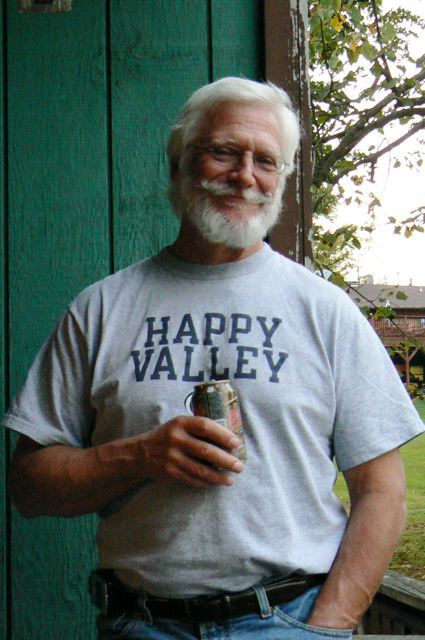
Dennis McFadden

Author photo by Heidi Brown

Sunday, July 7, 2013

The Book Auction

…or Golly, There are People Who Spend Lots More On Books Than I Do!

Though I have thousands of books, I am no book collector. Years ago, I bought a copy of The House of Barrymore at the Atlantic Book Warehouse. I had called ahead to have the book held for me so was perplexed when I went to pick the book up. A very serious young man gave me a doleful look.

“We do not have the book,” he said.

“But I was assured it was set aside for me.”

“The only book we have is flawed.”

Now when I was in grad school I learned about the concept of textual depravity and got a sharp look from a professor when I laughed like a loon at the idea. Somehow I didn't think that's what we were talking about here.

“Well, unless there are pages missing, I think I can cope.”

The young man reluctantly brought the book to me. I examined it closely; it looked fine.

“See here. The front jacket flap does not align with the edge of the book.”

Was he serious? He was.

I insisted that I would take the book; I assured him that as a reading copy the book was flawless. I know he thought less of me as a person but he agreed to sell me the book.

I hadn’t thought of this incident in years until my husband and I attended a book auction at Swann gallery two weeks ago. Bob wanted to see an auction for some research he’s doing and since everything I know about the rare book business comes from John Dunning’s Cliff Janeway novels, I thought this would be fun.

Truly, I expected to be met at the door by someone who would say, “You’re not dressed appropriately for an auction. You’re wearing stretchy leggings and a T-shirt.”

But we were greeted warmly and given lovely catalogs of the books to be auctioned. (My T-shirt came from the British Museum’s “Shakespeare: Staging the World” exhibit so maybe that made a difference.)

I scanned the shelves and then found a seat that put me right next to novels by Dickens and Chandler. The auction was a decorous affair but there was certainly tension as some books elicited fierce bidding between the people in the auction room and those in touch by phone or on the internet. Among the books getting the highest bids:

Arthur Conan Doyle’s The Lost World (expected to go for between $6,000-$9000, it sold for $19,000) I think if you spend this much money for book you should be allowed a heartfelt “Yippee!” or “Huzzah!” but as this world is not mine, I shouldn’t attempt to dictate behavior.

Harper Lee’s To Kill a Mockingbird. (expected to go for between $8,000-$12,000, it sold for $13,000). It was not only a first edition, but had a presentation card that read: “To Miss Ethel, with love, Nelle Harper, September 17, 1960.” I love the book. I own two copies, both serviceable paperbacks.

George Orwell’s Burmese Days (expected to go for between $3,000-$4,000, it sold for $14,000.) Please forgive me when I tell you that my first thought when I heard that astronomical sum was “Gee, I got that as part of a Kindle Featured Deal for $3.99.”


I would hate anyone to think that I left New York City without buying books. I visited Bluestockings on Allen Street where a very enthusiastic young lady assured me the store was the last bastion of radical feminism. Alas, they don’t ship books so I was unable to buy as much as I might like but I came away with The Autobiography of Mother Jones and four packs of feminist playing cards. Then I went to The Mysterious Bookshop (alas, several days before it became a tangoteria) and left a nice sample of my paycheck.

If you’re looking for a bookish night at the theater, may I suggest Matilda: The Musical? I was a touch discouraged when I heard a little girl behind me say, “Well, I guess I like reading books, sorta,” but Matilda herself is wonderful. In fact in a few years maybe she’ll be joining the folks at Bluestockings.

Stephanie Patterson

Friday, July 5, 2013

The Zoner Speaks

As you may know, I serve on the Board of Zoning Adjustment for the City of Lambertville. I did this as an alternate some twenty-five or thirty years ago, until it became more than I could manage with a full-time job and a small child. I re-upped five years or so ago when it appeared that I was needed. We are seven, not counting the alternates. Five votes are needed to grant a variance. We serve without pay, reviewing the submissions of those needing a variance, showing up for monthly hearings, doing the best we can for the people of the city.

Ordinarily the hearings are without drama. News reporters don't even show up to cover them. Every buildable square inch of the town has already been developed, and who cares, after all, if Joe Citizen needs a variance to put an apartment for his mother-in-law over the garage? (An extremely hypothetical example, by the way. Most homes in Lambertville have no off-street parking, still less a garage.)

But every now and then something important comes up. Someone seeks to build on the hillside, for example, which is not buildable, and is protected by the city's steep slope ordinance. To grant a variance in such cases would worsen the already bad storm water runoff problems up there, in the worst case sending a mudslide onto Route 29.

Or someone comes into town with a marvelous plan for turning the old Baptist Church into an exciting music venue where food and alcohol are served.

Since this plan sorely impacts the already difficult parking situation, and since it threatens to draw a crowd not normally seen on this side of the river (or this side of Bourbon Street during Mardi Gras, in the minds of some), passions are running high among the locals. Middle-class people live on the street behind the Baptist Church. The rumors alone are said to be affecting property values there.

Meanwhile the Lambertville Music Hall (a non-profit) has been pouring money into the church building for months now. Repairs and renovation were badly needed. The church looks good.

Members of the Zoning Board have been snowed under with letters begging us to turn their application down, and not just from immediate neighbors and competing restaurateurs. The mayor said at the last city council meeting that the Zoning Board of Adjustment alone was in charge of accepting or rejecting the Music Hall's application, and was free to ignore all the mail.

There are people in town who like the whole idea. Art. Music. What's not to like?

Last week the application came before the board. Actually it was a continuation of the application, which first came before the board last month. Over a hundred members of the public turned out in weather so bad that the board chairman opened the meeting by warning us that it might get worse. We should think, he said, about evacuating safely. But a hundred dripping wet, enraged people weren't going anywhere.

I took my seat on the dais with the rest of the Board, but only long enough to answer the roll call. Since my house is within two hundred yards of one of the parking lots the Music Hall proposed to use, I was forced under the law to recuse myself from the proceedings. So also was another board member, who lives out behind the church. And so was a third member. He had just discovered that he was involved in a business arrangement with one of the principals.

I went to the back of the room, where my facial expressions could not be seen by the other board members and possibly influence their decision. They told us to do that in Zoning Board school if we ever had to recuse ourselves. The crowd fell silent.

The lawyer for the Music Hall appeared nervous. He challenged the credentials of one of the members, who had been appointed and sworn in before the last meeting but had missed that meeting, getting up to speed by listening to the four-hour tape. The lawyer wanted him sworn in publicly and then forced to listen to the four-hour tape again. Our lawyer, the lawyer for the board, pointed out that this was unreasonable. I must explain that the reason we seemed so short-handed was that our chairman died suddenly two months ago and another member moved out of town and was thus unable to serve. And then there were the three of us who had to recuse ourselves.

Seeing that there were, in fact, enough people on the board to legally rule on the application, the Music Hall lawyer asked for five minutes to confer with his clients. They went out in the hall while the people in the room began talking and growling among themselves. When he came back he said that they were unwilling to go forward with the application with so few board members and asked for a postponement until next month. This request was granted. But it came from him, not from the board, and only after an attempt to disqualify one of the members and reduce the board still further.

Newspaper coverage of the brouhaha has been vague and inaccurate. The headline on the front page of the Beacon read, "Zoners unable to hold music hall hearings." Zoners. We're Zoners. I sort of like that. It sounds vaguely sinful. Maybe I'll have tee shirts made.

One of the members of the public asked that the next meeting be held in a larger venue, so that more than a hundred people could attend. The Music Hall offered the church for the meeting, but their offer was met with what I can only describe as a roar of rage from the public. The board chairman made a few calls, without success. The announcement of the next location was postponed. The meeting was adjourned, and we all went back out in the pouring rain.

A few days ago the board secretary emailed all of us Zoners the information that the Music Hall's architect had let her know that they were withdrawing their application. I thought this was interesting news, and I went to the Lambertville Facebook site and posted it, so that interested members of the public might know. It isn't as if they would read about it in the papers anytime soon. Or anyway not the real story, whatever that is.

It was like dropping a piece of meat in the piranha tank. So many with opinions, so few with understanding of the issues. People get really nasty sometimes when they think they're talking to strangers. Social media reminds me of the way some folks drive their cars. If you can't see people's faces it's okay to honk at them and give them the finger.

Anyway, without honking or giving the finger, I'll sign off for now, promising to keep you posted on what happens next, whether our little town collapses into a sinkhole of urban decay for lack of an exciting music venue in the middle of town or suffers a fatal influx of cars and drunken rock fans, putting an end to life as we know it. The Music Hall people may have withdrawn their application but they are still doing major landscaping in the church's back yard, located in the R2 zone. (That's residential.)

Kate Gallison


Wednesday, July 3, 2013

A Contest: Win an Autographed Copy of Blood Tango


First the beginning of the story:


Like many of his ilk, Malcolm Tent was a fisherman given to exaggeration.  One day he had an experience he was sure no one would believe so he never told anyone the story until he told it to me.  Now I will tell it to you.
It seems Mal was out in his boat fishing for carp one day.  The fishing was good, and he was reeling them in.  As he was removing a big one from his hook, he pricked the end of his finger, which started to bleed a little.  Mal reached into his pocket for his handkerchief.  As he pulled it out, his wallet fell out of the pocket, over the side of the boat, and began to sink out of sight before he could grab it.

Mal groaned, but he hardly had a second to comprehend the accident when a fish came to the surface with the wallet balanced on its nose.  Soon another fish came to the surface, and like a pair of seals with a ball at the zoo, they flipped the wallet around in a game of catch, and finally back into the boat.
Mal gave up fishing and exaggerating after that.  And he only once described how he became the only human being ever to see ….

A copy of Blood Tango to the first person to guess the ending and write it in the comments below. 

Monday, July 1, 2013

First-Draft Terror

Suzanne Chazin was our Guest Blogger a couple weeks ago. When I asked her for one, she sent me two. The other, describing how she starts a new novel, is a howl. Who hasn't suffered this way?

Robert Knightly


I’m about to start the first draft of a new novel. This instills in me all the self-confidence of two virgins in a MINI Cooper. I’m sweaty and awkward. I don’t have a clue where anything goes. And I’m already questioning whether this was the right vehicle for attempting this in the first place.

I don’t know why first drafts scare me so much. It’s not as if I don’t know by now that I’ll be rewriting it all in a few months anyway. You’d think, with three published novels and a finished fourth manuscript behind me, I’d be like Larry King at the altar: ring in one pocket, attorney on speed dial in the other. I know what’s coming—the revisions, the tossed scenes, the killed characters, the discoveries I won’t make until I’m practically finished with the draft. And yet I will do almost anything to delay the process. This past week alone, I have:

  1. Transferred all of my children’s baby pictures to DVD
  2. Volunteered to be on the interview committee for the new principal of my daughter’s middle school
  3. Filled out my bank’s customer satisfaction survey (probably a first in the history of my bank)
  4. Actually listened to the Jehovah’s Witnesses who came to my door.

I’m so desperate I called up GEICO to see if I could save money on my car insurance. (Don’t let the Cockney accent fool you; the lizard is a liar).

I’m really starting to panic.

I’m stalling by researching stuff I will never, ever need to know. The Internet is great for this. I can start off with a simple question about common Honduran surnames for my new mystery series about a Latino detective in suburban New York and end up two hours later reading the history of the Indian ruler Lempira who fought the Spanish and now has the Honduran currency named after him. (Pause to reflect: would the U.S. be in any better shape if our bills were called “Geronimos”?)

My first mystery series, set in the New York City Fire Department, provided loads of fun researching how to start fires and blow up things. There is nothing like watching a video of a room turning into a solid wall of flame in under three minutes to give one an Old Testament appreciation for how fast things can go wrong. Makes that unexplained clunk in my car and the untraceable leak beneath my kitchen sink feel like good Karma by comparison.

Here’s where a well-conceived outline would come in handy. I love outlines. I really do. Wish I could write one. Typically I start out with three pages of notes for the first chapter and by chapter five, I’m down to descriptions like, “someone dies here” and “they have good sex.” (Is there any other kind in fiction?) The truth is, I just don’t know what’s going to happen until it does. I write great outlines for my second drafts. But that’s like waiting for the medical examiner when what you really needed was the doctor. It’s so much more convenient to catch the problem before the patient stops having a pulse.

I know what I have to do. I have to write something awful—something I would only show to my mother when she was alive, and only then, after she’d had a couple of glasses of good red wine. And then I have to believe that it will get much, much better as I lay down more of the story. To build a smooth road, you always have to start with a pile of rocks.

Chinese Fortune-cookie stuff, I know. But it also happens to be true. I had an art teacher at Northwestern University named George Cohen who once instructed every student to paint the “best” painting he or she could create. In the second class, Cohen asked every student to paint the “worst” painting. Then Cohen papered the room with all of our artwork and asked students to vote on the best pieces. About 75 percent of the pieces voted as “best” were the ones we had painted as our “worsts.” (Makes me wonder about my other decisions in life.)

So I will try to be fearless and not worry about what’s “best” and what’s “worst.” I will try to have faith that over time, there will be a road through the wilderness.

Then again, I could always start another blog…

Suzanne Chazin