Any writer who has the nerve to wade into the murky world of crime novels has a lot of guts. Talent also. Plus allegiance to fellow members of the unique Tribe called Crime Novelists.
When you admit to non-Tribals you are a Writer, often their eyes glaze over, as they give you "that" patronizing smile.
Then, when you whisper the word - CRIME - they put on their protective shields, stammer they have an urgent meeting, and vanish…
But mention the magic word C-R-I-M-E to a fellow Tribal and you are at once held by the warmth of instant bonding!
Most folks who write Crime Fiction are far from being criminals themselves. Most of us are guardians of our Precious Earth Planet.
We have deep respect for Fellow Tribesmen, regard them as dear friends and colleagues.
I bear great honor for people of my Tribe… some names are engraved upon my soul: Marilyn Henderson, author of over 60 novels, who honored me as Crime Book Reviewer for her early email work, Lady M.
Mel Berger, eminently wise agent of the Great and Famous, who is the best writing coach on the planet!
And many others: Alice Orr, versatile early pillar of the Mystery Writers, Leslie Budewitz, now SinC President, a thoughtful sharer.
Bob Knightly, Esquire, Jim Fusilli, Al Ashforth, for diverse expertises and professionalism.
Andy Peck, whose lawyerly guidance taught us how to stay within the boundaries.
Hallie Ephron, Hank P. Ryan, and Robin Hathaway (R.I.P.), who share with untold numbers of crime-writing Tribals their wisdom.
Earl Staggs and Kaye Barley, two of the friendliest Tribals on the planet!!
The hundreds of crime writers who have inspired us, not only with their writing, but their braininess and guts in swimming through the icy torrents to get published!
Please give your thanks, as I do today, for the Tribals in your life, who have inspired, nurtured, advised you --- in your own swim through the icy waters of the sea of publishing!
Tell us who your own Tribal Guides have been !!!!!
Thelma J. Straw
Showing posts with label Crime writing. Show all posts
Sunday, December 13, 2015
Friday, June 12, 2015
Once More Unto the Breach, Dear Friends
I once was on a panel—I think it was at Bouchercon—discussing authors who rose from the ashes of miserable failure to regenerate their writing careers. Janet Reid, famous agent, was in the audience. I was talking with her later. She found it annoying that the cessation of a series of projects, or the leaving of a certain publisher, or even a certain agent, should be referred to as “failure.” This is the normal course of a writer’s career, she said. It’s not failure.
It didn’t occur to me to mind being branded a former failure, since I come from a race of cold-blooded, slow-witted northern Europeans who take five or six months to realize they’ve been insulted. Writing careers do tend to wax and wane, and mine certainly has. My first book—did I ever tell you about that?—was reviewed in the New York Times, favorably, I might add, and earned out its advance plus a thousand dollars more in royalties. It was a quirky detective story called Unbalanced Accounts.
Jonathan Kellerman’s first book was written up in the same review. His writing career from that point on did better than mine. It may have been that he was more diligent about promoting himself. It may have been that he worked harder at writing and had fewer distractions. It may be that he is simply a better and more entertaining writer than I am, or scarier, or less quirky, or more firmly plugged into the zeitgeist. In any case I’d be willing to bet that nobody ever put him on a failure panel.
So time went on. A number of publishers took me up and put me down again. The detective series reached a logical end. Time for something completely different. I wrote Bury the Bishop, the first in a series of traditional clerical mysteries. A Dell paperback, Bury the Bishop is the most successful thing I’ve written so far in terms of copies sold. After four more in that series my publisher let me go and my agent quit the business. They all said, “I hope you won't stop writing.” Why would I do that?
At the time of the aforementioned Bouchercon rising-from-failure panel I had a new agent who had just sold The Edge of Ruin, a historical murder mystery about the early days of the movie industry, as well as its sequel, The Brink of Fame, to St. Martin’s Press. The day after I accepted a prize for The Edge of Ruin from the New Jersey Studies Academic Alliance it was remaindered. Come to find out I was supposed to sell it myself. Who knew?
I thought, if that’s the way things are done these days I might as well self-publish. So I wrote a little fantasy set in Lambertville and called it Monkeystorm. It had a video game in it and a couple of grisly murders. The protagonist was mental, in a charming sort of way. But the title didn’t really work. Nor did the cover, which was too scary for the book. A good publisher would have fixed those things, maybe even promoted the book. But, alas, you see. So nobody bought that one either. My friend Mark liked it. He’s a Terry Pratchett fan, which gives you some idea.
Still I refuse to stop writing. Once again it’s time for something completely different, and this time I’m going to undertake to write a spy thriller set in New York in 1915. Animals will be killed. It’s not a cozy. There was a war on, for Pete’s sake. Bad things happened.
So here goes. Wish me luck. You know what they say: if you never try anything, you’ll never fail, but then you’ll never succeed, either.
© 2015 Kate Gallison
It didn’t occur to me to mind being branded a former failure, since I come from a race of cold-blooded, slow-witted northern Europeans who take five or six months to realize they’ve been insulted. Writing careers do tend to wax and wane, and mine certainly has. My first book—did I ever tell you about that?—was reviewed in the New York Times, favorably, I might add, and earned out its advance plus a thousand dollars more in royalties. It was a quirky detective story called Unbalanced Accounts.
Jonathan Kellerman’s first book was written up in the same review. His writing career from that point on did better than mine. It may have been that he was more diligent about promoting himself. It may have been that he worked harder at writing and had fewer distractions. It may be that he is simply a better and more entertaining writer than I am, or scarier, or less quirky, or more firmly plugged into the zeitgeist. In any case I’d be willing to bet that nobody ever put him on a failure panel.
So time went on. A number of publishers took me up and put me down again. The detective series reached a logical end. Time for something completely different. I wrote Bury the Bishop, the first in a series of traditional clerical mysteries. A Dell paperback, Bury the Bishop is the most successful thing I’ve written so far in terms of copies sold. After four more in that series my publisher let me go and my agent quit the business. They all said, “I hope you won't stop writing.” Why would I do that?
At the time of the aforementioned Bouchercon rising-from-failure panel I had a new agent who had just sold The Edge of Ruin, a historical murder mystery about the early days of the movie industry, as well as its sequel, The Brink of Fame, to St. Martin’s Press. The day after I accepted a prize for The Edge of Ruin from the New Jersey Studies Academic Alliance it was remaindered. Come to find out I was supposed to sell it myself. Who knew?
I thought, if that’s the way things are done these days I might as well self-publish. So I wrote a little fantasy set in Lambertville and called it Monkeystorm. It had a video game in it and a couple of grisly murders. The protagonist was mental, in a charming sort of way. But the title didn’t really work. Nor did the cover, which was too scary for the book. A good publisher would have fixed those things, maybe even promoted the book. But, alas, you see. So nobody bought that one either. My friend Mark liked it. He’s a Terry Pratchett fan, which gives you some idea.
Still I refuse to stop writing. Once again it’s time for something completely different, and this time I’m going to undertake to write a spy thriller set in New York in 1915. Animals will be killed. It’s not a cozy. There was a war on, for Pete’s sake. Bad things happened.
So here goes. Wish me luck. You know what they say: if you never try anything, you’ll never fail, but then you’ll never succeed, either.
© 2015 Kate Gallison
Thursday, October 30, 2014
You're Done. Now the Work Starts
![]() |
| Photo Credit: Jim Nedelka |
This is the way I’d always envisioned the writer’s life.
And
you get to live it . . .
for about one month after your book’s published. You get to chat about your book with mystery readers on guest blogs, talk about it on library panels with famous writers, and show up at bookstores where people have come to see you, listen to you read, ask you questions about your book, and laugh at your jokes (your friends in the audience will even laugh at the ones they’ve heard too many times before).
Then you have to get back to writing.
After the interruptions in my routine, pleasant as they have
been, it’s been hard to settle back in fully.
Among writers, we have a word for
this: procrastination.
![]() |
Wallace Stroby, Mistina Bates and I
laughing at something Dennis Tafoya said at a
library panel in Chatham NJ. At the unseen end of the table,
also laughing, is Dave White,
Derringer Award-winning author of the Jackson Donne series. Sorry, Dave, but I chose this particular shot because it's a great picture of me.
|
But I’ve been thinking a lot about writing. And about some of the questions I’ve been asked in the last month from new writers trying to sell their first books.
If you're not a writer, let me quickly explain the process. When
you’re trying to get a book published, you generally need an agent. So you send
a pitch letter, making your book sound as scrumptious
as possible. If your pitch letter sparks interest, you’re asked to submit
sample chapters. This part of an author’s life is known as Pure Hell. You will
generally be rejected. And the rejection letters won’t necessarily help you
figure out what might be wrong with the book. “Love the villain; the story’s
not quite there yet.” “Terrific tale; villain needs some work.”
And once you’ve been rejected by an agent, that door is generally
closed for that particular book.
Soooooo... If you’re a new writer, and you’re thinking about sending
out that just-finished first book, here are a few random thoughts for your
consideration from a woman whose first book took more than 10 years to "finish":
1. Your book isn’t finished, not unless you’re on draft
240. So, let’s move on to #2.
2. Write the best book you can. Okay, okay, I can
hear you go, “Well, duh.” But sometimes, new writers are under the
impression that “a lot of books out there just aren’t that good.” This is
dangerous thought. You’ll convince yourself that doing less than your best will
be enough. It isn’t.
3. Kill off your extras — before they kill your
plot. Don’t make the reader keep track of too many characters, and I say this as
a recovering characteraholic. Ah, the sweet lure of just one more new voice in
the story. But before you know it, you’ve got 20 characters, all necessary to
the plot. And don’t introduce more than 3 at the same time. Even Rex Stout
couldn’t pull that off — see The League of Frightened
Men, Chapter 5. So, how do you keep yourself in line?
4. Put your characters in a line-up. Keep a
detailed file. Don’t wing this; write it down. You might think you'll recall all
the details about them because they’re so precious to you. But you won’t. List
them, describe them, and include the descriptions you used in the book so you
can remove repetitions later on. (This will also help you if your book turns into a series. You never have to scramble to recall how you described a continuing character in previous books.) Set down their motives, opportunities, and
their contribution to the mystery. You’ll have a clearer picture of which characters can be combined, and which suspects aren't necessary and can be bumped off (the page).
5. Don’t try to play journalist. Think long and hard before adding a plot element or character that would require quoting portions of news articles. Even excellent writers have terrible trouble pulling off writing like a journalist.
6. Sing out, Louise. Read your chapters out loud. And read them like you’re telling an intriguing story, not reciting the Gettysburg Address in fifth grade. You’ll discover where the momentum breaks down, where your interest flags. You’ll find places where the rhythm is off. If your heroine is sweeping diva-style across a room, the prose flow will be much different than if she’s crawling through a pitch-black house, looking for a way out before the killer finds her. Read in the voices of your characters — even if you don’t perform them very well. Nobody has to hear you reading. But don't assume that just because you watch Downton Abbey you can write a British character. Vet dialog with people who actually come from the place whose syntax you’re trying to mimic.
7. Write the best book you can. Sometimes, we have
to be reminded.
Thank you, Michael Connelly, for making that so clear to me in the very first writing symposium I ever attended. In the end, it’s about the writing.
I think I’ll get back to that now.
![]() |
| At Mysterious Bookshop in New York City, being introduced by manager Ian Kern. Photo Credit: Mariann Moery |
REMINDER: At Goodreads, there's still time to register to win a signed copy of NO BROKEN HEARTS: Enter to Win a Copy. Goodreads uses an algorithm to select the winners, on October 31, which takes the selection pressure off the writer.
Tuesday, October 14, 2014
Award-winning Crime Novelist Charles Salzberg Strikes Again
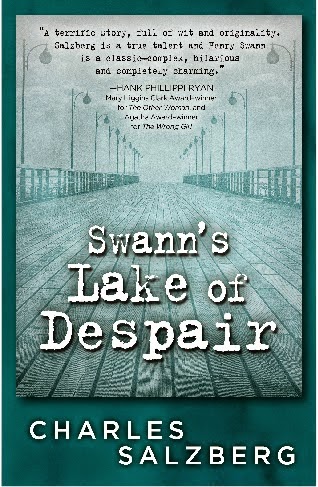
Fans of Charles Salzberg's Henry Swann will be pleased to know that the third in the series comes out a week from tomorrow. A New York-based novelist, journalist and acclaimed writing instructor, Charles is the author of Devil in the Hole, chosen as one of the Best True Crime Novels of the Year by Suspense Magazine, and the Henry Swann detective series featuring Swann’s Last Song, which was nominated for a Shamus Award for Best First PI Novel; Swann Dives In; and the upcoming Swann’s Lake of Despair.
I never planned on being a crime writer. And yet it probably turned out to be the best thing possible for my writing career, which began for me, as it did for so many other English majors, with a desire to write the Great American Novel. But I was self-aware enough to know I’d never write a great novel, one that came even close to my heroes, Nabokov, Bellow, Roth and Mailer. Instead, I was willing to settle for a good literary novel.
But when I realized that wouldn’t pay the rent I stumbled into a career as a magazine journalist. Although I wrote about pretty much any subject under the sun, I was always fascinated by crime and even worked on a true crime book called Dead End. But I never stopped writing fiction and about 25 years ago what started out as an experiment in writing what a friend of mine called, “an anti-detective novel” ended up as a novel called Swann’s Last Song. The novel begins with a murder having already taken place and there are several other random unconnected killings along the way, but it’s really about identity since Swann, who abhors violence and whose specialty is finding lost people, winds up not trying to find the murderer but rather to find out who the victim really was and, along the way, who he is. I, of course, thought it was a brilliant idea, but agents and publishers didn’t share my enthusiasm. And so, for twenty years the novel languished on my computer, until I dusted it off, updated it, and finally “sold out” by having Swann solve the crime. Boom! It sold. (You can actually find my original ending in the paperback edition.)
Although written as a one-off (in the original version Swann becomes so disillusioned he quits the business), to my surprise it was nominated for a Shamus award and when I lost I got pissed off enough to decide I’d keep writing them until I won something.
With no offense to my fellow crime and mystery writers, because I admire so many of them, I decided to take a different path within the genre. Each Swann novel was going to present me with a different challenge. To me writing the traditional detective mystery, where there is a dead body, a host of likely suspects, the detective solves the crime and the book ends, was a kind of death in itself. The truth is, I couldn’t do that even if I wanted to, because I’m not particularly good at tight plotting nor with lining the pages with clever clues for the detective and reader to follow.
Instead, I decided to not only focus on character but also push the envelope in terms of what people might expect in a detective novel.
For instance, in the second in the series, Swann Dives In, not only are there no dead bodies but the reader isn’t quite sure what the crime is until more than half-way through the book and by the end of the book isn’t even sure a crime was committed.
In the third in the series, Swann’s Lake of Despair, I set myself another challenge. I would have Swann investigate three separate cases at the same time, each unrelated to the other, none of them involving murder.
Why? Because to me murder is overrated. On TV each week the viewer is assaulted with perhaps twenty to thirty murders—and in a show like The Following, there can be that many murders in a single episode. But in real life, how many of us are actually affected by murder? Sure, we read about them in the newspapers and hear about them on the television news, but for the most part, it’s not our reality. On the other hand most of experience or even commit other kinds of crimes every day, sometimes more than one. They might be petty crimes, like stealing supplies from where you work. Breaking a loved one’s heart. Cheating on a test. Lying. Misrepresentation. These crimes might not be punishable by a stint in prison, but they are crimes nonetheless. And they can be very personal crimes: crimes that might hurt us deeply.
These are the kinds of crimes I’m more interested in writing about and these are the crimes Swann is called on to solve.
Thinking back, I realize I was profoundly influenced by a 1960s television series called The Naked City. What would be called a police procedural today, there was, of course, a crime committed every week. But often these crimes did not involve murder. Instead, the show, which had “eight million” stories from which to draw, focused on character, deceit, unhappiness; on broken hearts as much as broken heads.
This is what I tried to capture in Swann’s Lake of Despair. In one case Swann is hired by a distraught fellow whose girlfriend has disappeared. His heart is broken, he feels betrayed. In another, Swann seeks to find a lost journal that might shed light on an eighty-year old death that might or might not have been murder or suicide. In the third, he’s hired to find a portfolio of lost photographs by a long since deceased photojournalist. The latter was inspired by a friend and former student of mine, Julia Scully, a wonderful writer whose second memoir in progress (her first was called Outside Passage and was published to wide acclaim), told about her life as an editor in the world of photography in the 1950s and ‘60s. Julia allowed me to ransack her life for this plotline.
And so, if you’re looking for dead bodies, you probably won’t find them in my Swann books. But then again, I love to break rules, even my own, and if it just “happens” organically in the plot, well, you never know, blood might just flow someday.
© 2014 Charles Salzberg
I never planned on being a crime writer. And yet it probably turned out to be the best thing possible for my writing career, which began for me, as it did for so many other English majors, with a desire to write the Great American Novel. But I was self-aware enough to know I’d never write a great novel, one that came even close to my heroes, Nabokov, Bellow, Roth and Mailer. Instead, I was willing to settle for a good literary novel.
But when I realized that wouldn’t pay the rent I stumbled into a career as a magazine journalist. Although I wrote about pretty much any subject under the sun, I was always fascinated by crime and even worked on a true crime book called Dead End. But I never stopped writing fiction and about 25 years ago what started out as an experiment in writing what a friend of mine called, “an anti-detective novel” ended up as a novel called Swann’s Last Song. The novel begins with a murder having already taken place and there are several other random unconnected killings along the way, but it’s really about identity since Swann, who abhors violence and whose specialty is finding lost people, winds up not trying to find the murderer but rather to find out who the victim really was and, along the way, who he is. I, of course, thought it was a brilliant idea, but agents and publishers didn’t share my enthusiasm. And so, for twenty years the novel languished on my computer, until I dusted it off, updated it, and finally “sold out” by having Swann solve the crime. Boom! It sold. (You can actually find my original ending in the paperback edition.)
Although written as a one-off (in the original version Swann becomes so disillusioned he quits the business), to my surprise it was nominated for a Shamus award and when I lost I got pissed off enough to decide I’d keep writing them until I won something.
With no offense to my fellow crime and mystery writers, because I admire so many of them, I decided to take a different path within the genre. Each Swann novel was going to present me with a different challenge. To me writing the traditional detective mystery, where there is a dead body, a host of likely suspects, the detective solves the crime and the book ends, was a kind of death in itself. The truth is, I couldn’t do that even if I wanted to, because I’m not particularly good at tight plotting nor with lining the pages with clever clues for the detective and reader to follow.
Instead, I decided to not only focus on character but also push the envelope in terms of what people might expect in a detective novel.
For instance, in the second in the series, Swann Dives In, not only are there no dead bodies but the reader isn’t quite sure what the crime is until more than half-way through the book and by the end of the book isn’t even sure a crime was committed.
In the third in the series, Swann’s Lake of Despair, I set myself another challenge. I would have Swann investigate three separate cases at the same time, each unrelated to the other, none of them involving murder.
Why? Because to me murder is overrated. On TV each week the viewer is assaulted with perhaps twenty to thirty murders—and in a show like The Following, there can be that many murders in a single episode. But in real life, how many of us are actually affected by murder? Sure, we read about them in the newspapers and hear about them on the television news, but for the most part, it’s not our reality. On the other hand most of experience or even commit other kinds of crimes every day, sometimes more than one. They might be petty crimes, like stealing supplies from where you work. Breaking a loved one’s heart. Cheating on a test. Lying. Misrepresentation. These crimes might not be punishable by a stint in prison, but they are crimes nonetheless. And they can be very personal crimes: crimes that might hurt us deeply.
These are the kinds of crimes I’m more interested in writing about and these are the crimes Swann is called on to solve.
Thinking back, I realize I was profoundly influenced by a 1960s television series called The Naked City. What would be called a police procedural today, there was, of course, a crime committed every week. But often these crimes did not involve murder. Instead, the show, which had “eight million” stories from which to draw, focused on character, deceit, unhappiness; on broken hearts as much as broken heads.
This is what I tried to capture in Swann’s Lake of Despair. In one case Swann is hired by a distraught fellow whose girlfriend has disappeared. His heart is broken, he feels betrayed. In another, Swann seeks to find a lost journal that might shed light on an eighty-year old death that might or might not have been murder or suicide. In the third, he’s hired to find a portfolio of lost photographs by a long since deceased photojournalist. The latter was inspired by a friend and former student of mine, Julia Scully, a wonderful writer whose second memoir in progress (her first was called Outside Passage and was published to wide acclaim), told about her life as an editor in the world of photography in the 1950s and ‘60s. Julia allowed me to ransack her life for this plotline.
And so, if you’re looking for dead bodies, you probably won’t find them in my Swann books. But then again, I love to break rules, even my own, and if it just “happens” organically in the plot, well, you never know, blood might just flow someday.
© 2014 Charles Salzberg
Tuesday, October 7, 2014
Joyce Tremel's First Book is Off and Running
Joyce Tremel, today's guest writer, was a police secretary for ten years. Like most of us, she more than once envisioned the demise of certain co-workers, but settled on writing as a way to keep herself out of jail. She lives in a suburb of Pittsburgh with her husband and a spoiled cat. Her debut mystery, TO BREW OR NOT TO BREW, will be released by Berkley Prime Crime in Fall 2015.
The last time I wrote a post for yinz guys (as we say here in Pittsburgh), was almost two years ago. I had a book on submission at the time that ultimately didn’t sell. While that manuscript made the rounds, I wrote a proposal for a cozy series that my agent sold to Berkley earlier this year. The first in the series, TO BREW OR NOT TO BREW, will be released in the Fall of 2015. Here’s a little bit about it:
Someone doesn’t want the Allegheny Brew House to open, and Maxine “Max” O’Hara is determined to find out why.
With her brand-new brewmaster certification in hand, Max has been working twelve hour days getting the abandoned Steel City Brewery up to code, perfecting beer recipes, and learning the business. A lot of work, but she’s sure she made the right decision—until things start to go wrong. She’s not too worried until the minor annoyances get progressively worse. And when she finds the body of her assistant brewmaster and chef in one of the beer tanks, she knows that batch wasn’t brewed according to Reinheitsgebot.
It’s been an interesting experience writing a book with a deadline. Since the series sold on proposal (a synopsis and three chapters), I had about nine months to finish it. I turned it in a couple of weeks ago. But there’s no time to relax—the next one is due in nine months.
Is my writing life any different now? Yes and no.
I still write every day, so that part hasn’t changed. The difference is now I HAVE to get the words on the page. I’m still busy with all the same things I had before, but now the writing comes before cleaning the house (as I stare at the clumps of cat fur on the floor). I’m learning to write a little more quickly. I no longer have the luxury of writing and deleting the same paragraph fifty times in a day. I’ve cut back to…oh…maybe ten times, lol.
I also had to increase my social media presence. I was already on Twitter (www.twitter.com/JoyceTremel). At the suggestion of my editor, I now have a page on Facebook (www.facebook.com/JoyceTremel). I really love Twitter. I’m not too sure about Facebook yet, probably because I’m still trying to figure it out. As far as networking goes, Twitter wins, hands down. It’s so much easier to meet people and interact with them. To me, FB seems more like talking AT people, instead of conversing with them. Maybe it’ll grow on me. We’ll see.
Well, that was a lot of rambling about nothing, wasn’t it? I do have a dentist appointment this morning, but I’ll be back to chat. I’ll be happy to answer any questions about the series, writing, social media, or beer. Especially beer.
Joyce Tremel
The last time I wrote a post for yinz guys (as we say here in Pittsburgh), was almost two years ago. I had a book on submission at the time that ultimately didn’t sell. While that manuscript made the rounds, I wrote a proposal for a cozy series that my agent sold to Berkley earlier this year. The first in the series, TO BREW OR NOT TO BREW, will be released in the Fall of 2015. Here’s a little bit about it:
Someone doesn’t want the Allegheny Brew House to open, and Maxine “Max” O’Hara is determined to find out why.
With her brand-new brewmaster certification in hand, Max has been working twelve hour days getting the abandoned Steel City Brewery up to code, perfecting beer recipes, and learning the business. A lot of work, but she’s sure she made the right decision—until things start to go wrong. She’s not too worried until the minor annoyances get progressively worse. And when she finds the body of her assistant brewmaster and chef in one of the beer tanks, she knows that batch wasn’t brewed according to Reinheitsgebot.
It’s been an interesting experience writing a book with a deadline. Since the series sold on proposal (a synopsis and three chapters), I had about nine months to finish it. I turned it in a couple of weeks ago. But there’s no time to relax—the next one is due in nine months.
Is my writing life any different now? Yes and no.
I still write every day, so that part hasn’t changed. The difference is now I HAVE to get the words on the page. I’m still busy with all the same things I had before, but now the writing comes before cleaning the house (as I stare at the clumps of cat fur on the floor). I’m learning to write a little more quickly. I no longer have the luxury of writing and deleting the same paragraph fifty times in a day. I’ve cut back to…oh…maybe ten times, lol.
I also had to increase my social media presence. I was already on Twitter (www.twitter.com/JoyceTremel). At the suggestion of my editor, I now have a page on Facebook (www.facebook.com/JoyceTremel). I really love Twitter. I’m not too sure about Facebook yet, probably because I’m still trying to figure it out. As far as networking goes, Twitter wins, hands down. It’s so much easier to meet people and interact with them. To me, FB seems more like talking AT people, instead of conversing with them. Maybe it’ll grow on me. We’ll see.
Well, that was a lot of rambling about nothing, wasn’t it? I do have a dentist appointment this morning, but I’ll be back to chat. I’ll be happy to answer any questions about the series, writing, social media, or beer. Especially beer.
Joyce Tremel
Thursday, September 25, 2014
A Look, Then a Book
My new Lauren Atwill adventure, NO BROKEN HEARTS,
has just been published!
For about six more weeks, my life will be frenzied, as I
squeeze in writing guest-blogs, throwing a launch party, visiting bookstores,
and preparing for conventions and library events to promote the book, while
feverishly trying to finish the next book.
Kind of what I dreamed about since I
was a kid. Of course, in my kid-dreams, I had a secretary who’d take care of
the schedule and just point me in the right direction.
At Goodreads, I’m giving away 20 signed copies of NO BROKEN
HEARTS: Enter to Win a Copy. Please put your name in the hat, as it were. Goodreads uses an
algorithm to select the winners, on October 31, which takes the selection pressure off
the writer. Whew.
Readers often ask, “Where do you get your ideas?”
I say, “If I knew, I’d have more and better.”
Writers rarely know where inspiration comes from. We
understand, sometimes, how to create conditions conducive to leaps of
imagination. But then sometimes we’re driving aside the maniacs on the Garden
State, thinking about nothing except getting home alive, and suddenly we know
how to fix that hole in our plot. How does this happen? We really don’t know.
When I started NO BROKEN HEARTS, I had a (really) vague idea
of a story that would involve my amateur sleuth/screenwriter Lauren being loaned out to a second-rate studio
by the major studio with which she's just signed a contract for her first screen
credit in years. Start with something that would make her really angry!
Conflict on page 1!
Then, as I do in all my books, I take a Hollywood scandal
(from any era), imagine it into the 1940s and wonder, “How can I make this even
worse?”
The scandal in NO BROKEN HEARTS is a Hollywood rumor from
the Golden Age that a legendary male star (whose name I won’t repeat because I
doubt this story) once accidentally killed someone and his studio paid off an
underling to confess and serve manslaughter time for considerations of money
and employment afterwards. How could this be made worse? How far would a
studio really go to protect a star? Would they cover up a murder?
Of course, Lauren would find the body, and be told to go along with the
studio’s story. If she doesn’t, nobody would believe her. And she’d be
blackballed. And maybe she really doesn’t think the star did it because of
something she saw at the scene. And then the real killer could realize he left a trail and come
after her.
Yeah, that would make things worse.
Next, I looked through pictures, for ideas for settings,
clothing, period details for the book, but mostly to pull me back into the
1940s and excite me about traveling there again. Pictures open the door to
my imagination much more powerfully than music (which works wonders for many
other writers).
I flipped through my files, searched favorite web sites, and
the pages of books.
And then, there it was.
This is Ronald Coleman, an actor from the Golden Age of film
whom I deeply admire. But I had totally forgotten this picture. From it, I
began to develop the fictional star Lauren has had a crush on since she was a
girl. She finally gets the chance to write for him, and then it all falls apart
in a brutal killing that could cost Lauren her career, and maybe her life, too.
Inspiration and its partner, enthusiasm, won’t write your
book for you. But sometimes one thing, one thing smoothes the path in
such a happy way.
If you’ve never seen Ronald Coleman’s work, I recommend the
classic 1937 version of The Prisoner of Zenda. Based on the wildly popular
book by Anthony Hope, it has so many rapturous traits of 19th c. romances –
malevolent scheming, wild coincidence, and outrageous twists. (And Douglas Fairbanks Jr. as a villain bonus!)
The charming but blasé
Rudolph (Coleman), traveling through the kingdom of Ruritania, notices some odd
glances in his direction. It turns out he bears a startling resemblance to the
soon-to-be-crowned king. Wouldn’t you know it, an other-side-of-the-blanket
birth has led to these men being near twins!! When the real king is kidnapped
to allow another to claim the throne, loyalists convince Rudolph to impersonate
the king.
The kidnappers can’t very well say, “Hey, that’s not the king! We
stole the king!”
In the end, Rudolph has turned hero and rescued the king, but
not before falling in love with his doppleganger's betrothed, played by Madeleine Carroll. The
last scene between these lovers-who-can-never-be . . .
Well, you should
see for yourself.
Copyright Sheila York 2014
Thursday, September 26, 2013
Watch on the Hudson
Last week, I spent a few days at Bouchercon, the largest of the US
mystery writer/fan conventions, held this year in Albany, New York, a couple of
hours up the Hudson River from my house.
Four swell things happened up there.
One, I was assigned a terrific panel on amateur sleuths, with
Catherine Astolfo, Kate George and M.K. Graff. Here’s a pic of me with moderator Nora McFarland,
who did a tremendous job – preparation is the key to spontaneity (and lots of
laughs)!
Second, Rose and Robert Knightly threw a buffet dinner for writers and readers at their lovely townhouse in Albany. It was the only location associated with the conference that did not seem to be uphill both ways.
Third, I discovered my opening line to the fifth Lauren Atwill mystery. [Book number 4 in the series is already cuddled up with the publisher, ready to go out next spring.] It’s weird how one line can generate so much enthusiasm to get to the computer each day.
Four, I was able to share with an audience of mystery fans a
portion of the screenshow I've created for presentations at libraries. Called “You
Can’t Put That in the Movies”, it’s
about the Production Code censorship in Hollywood
in the Golden Age of Film. [I blogged a bit about the Code back on April 25.] It’s always
good to get your work out before an audience: I saw I needed to shorten
it, to allow for more discussion afterward.
There’s one part of the presentation I’m pretty sure I’ll never cut: The
Production Code vs. Watch on the Rhine .
Let me tell you the story, briefly (I promise).
The 1943 film Watch on theRhine is based on a stage play by Lillian Hellman. Warner
Brothers wanted to turn it into a movie, and had submitted a preliminary script for Production Code Administration (PCA) review as was required by the Code office.
Let me tell you the story, briefly (I promise).
The 1943 film Watch on the
Spoiler Alert! Watch on the Rhine is s et in 1940, when Europe is at war but the US remains on the sidelines. Its hero is Kurt (Paul Lukas, who
played the role on Broadway), an engineer who’s been working in Europe and has returned to the US
with his family to visit relatives of his wife (Bette Davis, who took a smaller
role than she normally would because of her strong opinions about the subject
matter). It becomes clear along the way that Kurt has been working with and
raising money for anti-Nazis in Europe. When one of a network of
operatives is arrested, Kurt’s determined to go back to try to free the man, at great risk to himself.
The villain of the piece, a Romanian count called Teck, discovers all this, and
threatens to go to the German embassy with his information unless his silence
is purchased. Kurt kills him.
The PCA had some
‘suggestions’ for the final script. One in particular astonished and disgusted the playwright
Hellman, and here’s part of the letter
she wrote to the Code office. (I found the letters included here during research at the Margaret Herrick Library of the Academy of Motion Picture Arts and Sciences in Los Angeles.)
In the red-framed portion, she says “There is, however, one
suggested change which I find deeply shocking. Your office says that, in order
to have Teck killed by Kurt, it must be established that Kurt will be
assassinated if Teck reports him and that, having killed Teck, it must be
clearly established that Kurt has been finally killed by the Nazis.”
Yep, the PCA wanted Kurt to die.
Today in film, we grant vigilante rights to anybody who could even marginally be considered a protagonist. But the PCA took seriously its rule that crime cannot pay. Criminal acts – for example, taking the law into one’s own hands – were not allowed to go unpunished.
Here’s part of the letter Joe Breen – who was in charge of administering the Code – wrote to his boss, Will Hays, about the situation, no doubt in anticipation of the uproar that might occur if Hellman went public. Remember that in 1943, the US was fighting Germany in World War II.
He contends that in the movies under the Code, the law "can not be suspended, even when there is great provocation and even when we are at war." No matter the circumstances of a movie, no exceptions should be made.
And the PCA had the last word: they had to approve your script and your movie.
How did all this end?
No matter that America was at war, and that anti-Nazis were risking their lives every day in Europe, the Code office could not bring themselves to allow a man to kill
another outside the framework of the justice system, even in the circumstances set forth in the script. In
the released film, Kurt does kill Teck, and Teck is unarmed when it happens. Although the
killing is committed offscreen, it remains a shocking moment when this good man
marches Teck away. Kurt returns to Europe and
communication is lost (which would not have been unusual in time of war). He is
missing, but there is still hope he could be alive, which is the play’s
original ending. The compromise from the PCA was to allow the movie to retain it.
What Breen's (and the Code's) position ends up accomplishing of course is to make it very difficult to portray the risks faced by the anti-Nazi underground in Europe.
Lots of books have been written aboutHollywood ’s neglect of social and political
issues beginning from the moment the Code was adopted in 1934, and about Hollywood's unwillingness to take an
on-film stand against Nazi oppression, particularly of Jews, after it was clear what was happening in Europe with the rise of Nazism and even after America got into the war. While it’s true that Hollywood was careful not to offend the Hitler
regime in the 1930s (and threaten overseas revenues) and that the PCA even allowed the
German attaché in Los Angeles on occasion to review draft scripts during that period, the industry
was largely held hostage, not by Europeans, but by the considerable power of what most of us today would consider extremist views
inside the United States – racial, religious, ethnic. Studios were very reluctant to endanger their domestic business by opening themselves up to vitriolic charges that they were making "political" movies, advocating certain kinds of social change or promulgating before Pearl Harbor American involvement in what was often referred to as a "Jewish war" in Europe.
Lots of books have been written about
© 2013 Sheila York
Monday, July 15, 2013
On Umbrellas, Rule Books, and Other Writing Hazards
Robert Knightly
I am solemn, thoughtful, and prone to worry about anything that one can worry about. I am one of those people who is appointed to committees and given responsible tasks. When I fail to do what I said I would do or what I think I should have done, I suffer from pangs of guilt for days, weeks, months, or even years. I carry an umbrella and check the Weather Channel several times a day. And, yes, I do believe that sensible and fair rules should apply to both me and you. I am what most people would describe as a “serious person”.
However, after study, observation, and reaching the age of too old to worry about what others may think, I decided that a serious person functions much more effectively when she indulges in occasional silliness. Silliness from a serious person can be disconcerting for those who are convinced she has no sense of humor. They may be shocked or even distressed. But they will get over it. And the advantage for the serious person is that after having established in work and social situations that she can indeed tell a joke or engage in an imaginative leap, the serious person can then focus on what needs to be done. A twinkle in the eye, an occasional nod and sly smile, is sufficient to remind others that the serious person can engage in fun.
However, the idea of applying this life lesson to my writing did not occur to me until recently. Not to say that I have never had fun as a writer. But it was quiet, private fun. The kind of fun that a person who loves to do research has when she is reading an old newspaper and finds a wonderful detail that will be perfect for her book. The mouthed “Yes!” because she is in the library and knows that etiquette requires one not disturb other patrons.
When it comes to sitting down at my computer to write, I have often gone about it with teeth gritted, research notes in front of me, eye on clock or calendar. Writing requires discipline. Although it would surprise many people to learn this, I have no discipline. I am an expert when it comes to procrastinating. I would rather sprawl in an armchair, watching a really bad movie, than sit down at my computer to continue my struggle with a stubborn first draft. Having no discipline, I rely on my ability to instill anxiety in myself. I imagine the humiliation and trauma of missing a deadline.
So does Lizzie Stuart, the protagonist in my first mystery series. She is a criminal justice professor/crime historian, and, like her creator, a serious person. Not only because I began by writing what I knew, but because her own autobiography has convinced her that she has no other choice but to be responsible and controlled. She does not want to be her mother’s daughter. Five books into the series, she has loosened up a bit – thinks in part to her lover John Quinn, but also because of her own efforts. A reader once shared her concern that poor Lizzie never seemed to know where her next laugh was coming from. She does laugh more now. But she is always going to be earnest and concerned. That’s who Lizzie is, and neither one of us wants her to change.
But when I had the idea for a new series, featuring police detective Hannah McCabe, I wanted to do something different. Debuting with THE RED QUEEN DIES, the series will be set in Albany, New York in the near future. The first book takes place in 2019. I wanted to move a few years into the future so that I could think about where we might be headed. What will our world be like in a few years with changes in demographics, wars, haves and have nots, climate change, surveillance and privacy issues, and the interactions of humans and machines? I teach a course on crime and cities. I also wanted to think about how a city functions. But some aspects of the future, such as climate change, could be pretty scary. So it occurred to me that I needed balance. I want to write books in this new series that readers will find thought-provoking but not utterly depressing.
When I realized that if I intended to write about the near future in a real place (Albany, New York), I would need to create an alternate (or parallel) universe, my problem was solved. In the opening scene in The Red Queen Dies, the reader learns that seven years earlier, in 2012, the sighting of a UFO in the desert near Las Vegas sent fighter jets scrambling. And then the UFO disappeared in a blinding flash of light. In 2019, my Albany and my characters exist in a post-UFO world. It is a world that is similar to the world we know, but there are also differences in both the past and the present.
Once I had decided to engage in a bit of genre-blending with a UFO sighting in a crime novel, I was liberated. I could play. I love film noir and 1950s sci-fi movies. I love nursery rhymes and Alice in Wonderland. I love it when real life is stranger than fiction – as in the case of Abraham Lincoln and John Wilkes Booth in Albany. I decided to put all of this in my book, while writing a straight-forward police procedural. I decided to write a book that I would enjoy reading — and I did.
I don’t know how my experiment in deliberate playfulness will turn out. I hope readers will like THE RED QUEEN DIES and become hooked on the series. But, however it goes, this serious person stood on her head and wiggled her toes. I’m doing it again as I write the second book in the series (working title, COCK ROBIN's FUNERAL). The first draft is still heavy lifting, but I’m having fun.
Frankie Bailey
www.frankieybailey.com
Twitter: @FrankieYBailey
Author photo by Jeff Foley Photography
Monday, July 8, 2013
How I Became a Crime Writer, or, What I Did on my Summer Vacations
I met Dennis McFadden five years ago when I joined his fiction writers group here in Albany. He was the dean among a talented bunch. He had been getting his stories published in prestigious literary journals. I noted that he had crimes occurring in his stories; their pace reminded me of the atmospheric style of Louise Penny. After I dropped out to write Memoir (a special kind of fiction), Dennis's recessive crime writer's gene tunneled up (stories in 'Hitchcock' and 'Queen' and appearances in Best American Mystery Stories twice).
Robert Knightly
I must have been meant to be a writer. According to my mother, I was three years old when I looked through the bus window at a busy Washington, D.C., sidewalk and said, “Look at all the pedestrians.” Even then I was a phonetic exhibitionist.
It must have been meant to be, because my upbringing wasn’t much of a factor. Blue collar all the way. There weren’t many books around the house. Nobody in the family had gone to college. Dad told a few bad jokes when he was drunk, but no bedtime stories. I remember getting my hands on some Hardy Boys books (crime novels, now that you mention it), and when I was 15, I picked up a paperback called Boy With a Gun. It was, coincidentally, about a 15-year-old boy. It takes place during the Hungarian uprising, and the kid’s father and brother are killed, he ends up fighting in the revolution, and he and this 15-year-old girl are crazy about each other, but the end left me hanging. The kid was still fighting. The war wasn’t over. He and the girl (with whom I too was in love by then) still weren’t together. What happened? What the hell happened? I had to know.
So I wrote to the author, James Dean Sanderson, and asked him, and he actually wrote back! I tore open the envelope, about to have all my questions answered, all the mysteries revealed. But he didn’t tell me a damn thing. He was flattered, he said, that the book had affected me that way. He suggested I write an ending. I should write the damn ending! I should talk to my English teacher—I might even be able to earn credit for it.
The bastard.
Maybe that planted a seed, I don’t know, but I still never entertained writing, not seriously, until my senior year, when my English teacher spotted my “talent,” and singled me out for high and frequent praise. His name was MacBeth. That’s right. MacBeth.
Bruce MacBeth maybe, but MacBeth nevertheless.
How could I then not go on to college and major in English? I became known as a writer, publishing a couple of stories in the old “lit mag.” I was on my way. Then a funny thing happened. I took 10 or 15 years off after college to drink and party before I finally got around to writing again. My third book was pretty good, good enough to get me an honest-to-God New York City literary agent. But alas. All she succeeded in doing was getting me a higher class of rejections, and she dumped me after a year. In my despair, Irish activism caught me on the rebound, and I spent the next 15 years getting England out of Ireland. All I wrote during that period was propaganda, but I wrote it well and I wrote it plenty. And you know what? It wasn’t bad practice. Some of those satirical pieces were very much like short stories.
As Irish activism fell by the wayside when peace broke out (thanks in large part to me, I like to think), short satire evolved into short stories. Why not back to novels? Maybe because I hadn’t had one published? Maybe because I was getting older now, the green banana syndrome, hesitant to begin any two year projects? Maybe because I loved the high of finishing a story and craved it more often? I became an addict, jonesing for finishes.
One of my first stories was about an old rummy named Doodle O’Hanlon (my stories always start with character, before plot, before anything else), and I put him in Hartsgrove, a little town in western Pennsylvania bearing more than a passing resemblance to my own hometown. Then I wrote about 25 or 30 more Hartsgrove stories, as well as dozens of stories set elsewhere in the universe. I started sending them out, started getting them accepted in literary journals, small ones at first, then bigger. I was hooked. In 2008 I found myself at a writers conference at Colgate, the instructor liked my work, one thing led to another, and out of that happy serendipity, my collection, Hart’s Grove, was born, published by Colgate University Press in 2010.
A few months later, coming back to my desk from a meeting (yes, of course, the old day job), I noticed the red light on my phone. It was a voice message from a gentleman in the employ of Otto Penzler, calling to tell me that my story “Diamond Alley,” from Hart’s Grove, had been selected for inclusion in The Best American Mystery Stories 2011.
I hadn’t submitted the story. A couple of months later I was lucky enough to be able to meet and talk to Michele Slung, the screening reader for the series, at a Sisters In Crime luncheon in Albany (thanks to an invitation from Robert Knightly). She’d noticed an ad in a journal for Hart’s Grove, judged from the copy that it might involve mystery, and ordered it. I’m grateful her radar system is so extensive.
So how does a writer with little knowledge of the genre, who’s never attempted a thriller, a whodunit, or a procedural, end up in Best American Mysteries? No mystery. As I said, I start with character, but given human nature, crime and character go hand-in-hand. And as for mystery, that’s a part and parcel of everyone’s everyday life—mystery in the sense that we can never really know everything that’s happening in and around our lives, or anything that will happen after them. Maybe that’s why I write, why a lot of writers do: the lure of omniscience is hard to resist. It’s a good way to grapple with those everyday mysteries. It’s good to be God sometimes.
This year I had another story selected for The Best American Mystery Stories 2013, “The Ring of Kerry,” which appeared in the “New England Review” in the Fall. This time I did submit. Good radar or no, why leave it to chance? I also have stories slated to appear in “Alfred Hitchcock Mystery Magazine” and “Ellery Queen Mystery Magazine.” (I submitted them too.)
This has led my friend Bob to believe I’m a crime writer.
Guilty (appropriately enough). Proud to be.
Dennis McFadden
Author photo by Heidi Brown
Robert Knightly
I must have been meant to be a writer. According to my mother, I was three years old when I looked through the bus window at a busy Washington, D.C., sidewalk and said, “Look at all the pedestrians.” Even then I was a phonetic exhibitionist.
It must have been meant to be, because my upbringing wasn’t much of a factor. Blue collar all the way. There weren’t many books around the house. Nobody in the family had gone to college. Dad told a few bad jokes when he was drunk, but no bedtime stories. I remember getting my hands on some Hardy Boys books (crime novels, now that you mention it), and when I was 15, I picked up a paperback called Boy With a Gun. It was, coincidentally, about a 15-year-old boy. It takes place during the Hungarian uprising, and the kid’s father and brother are killed, he ends up fighting in the revolution, and he and this 15-year-old girl are crazy about each other, but the end left me hanging. The kid was still fighting. The war wasn’t over. He and the girl (with whom I too was in love by then) still weren’t together. What happened? What the hell happened? I had to know.
So I wrote to the author, James Dean Sanderson, and asked him, and he actually wrote back! I tore open the envelope, about to have all my questions answered, all the mysteries revealed. But he didn’t tell me a damn thing. He was flattered, he said, that the book had affected me that way. He suggested I write an ending. I should write the damn ending! I should talk to my English teacher—I might even be able to earn credit for it.
The bastard.
Maybe that planted a seed, I don’t know, but I still never entertained writing, not seriously, until my senior year, when my English teacher spotted my “talent,” and singled me out for high and frequent praise. His name was MacBeth. That’s right. MacBeth.
Bruce MacBeth maybe, but MacBeth nevertheless.
How could I then not go on to college and major in English? I became known as a writer, publishing a couple of stories in the old “lit mag.” I was on my way. Then a funny thing happened. I took 10 or 15 years off after college to drink and party before I finally got around to writing again. My third book was pretty good, good enough to get me an honest-to-God New York City literary agent. But alas. All she succeeded in doing was getting me a higher class of rejections, and she dumped me after a year. In my despair, Irish activism caught me on the rebound, and I spent the next 15 years getting England out of Ireland. All I wrote during that period was propaganda, but I wrote it well and I wrote it plenty. And you know what? It wasn’t bad practice. Some of those satirical pieces were very much like short stories.
As Irish activism fell by the wayside when peace broke out (thanks in large part to me, I like to think), short satire evolved into short stories. Why not back to novels? Maybe because I hadn’t had one published? Maybe because I was getting older now, the green banana syndrome, hesitant to begin any two year projects? Maybe because I loved the high of finishing a story and craved it more often? I became an addict, jonesing for finishes.
One of my first stories was about an old rummy named Doodle O’Hanlon (my stories always start with character, before plot, before anything else), and I put him in Hartsgrove, a little town in western Pennsylvania bearing more than a passing resemblance to my own hometown. Then I wrote about 25 or 30 more Hartsgrove stories, as well as dozens of stories set elsewhere in the universe. I started sending them out, started getting them accepted in literary journals, small ones at first, then bigger. I was hooked. In 2008 I found myself at a writers conference at Colgate, the instructor liked my work, one thing led to another, and out of that happy serendipity, my collection, Hart’s Grove, was born, published by Colgate University Press in 2010.
A few months later, coming back to my desk from a meeting (yes, of course, the old day job), I noticed the red light on my phone. It was a voice message from a gentleman in the employ of Otto Penzler, calling to tell me that my story “Diamond Alley,” from Hart’s Grove, had been selected for inclusion in The Best American Mystery Stories 2011.
I hadn’t submitted the story. A couple of months later I was lucky enough to be able to meet and talk to Michele Slung, the screening reader for the series, at a Sisters In Crime luncheon in Albany (thanks to an invitation from Robert Knightly). She’d noticed an ad in a journal for Hart’s Grove, judged from the copy that it might involve mystery, and ordered it. I’m grateful her radar system is so extensive.
So how does a writer with little knowledge of the genre, who’s never attempted a thriller, a whodunit, or a procedural, end up in Best American Mysteries? No mystery. As I said, I start with character, but given human nature, crime and character go hand-in-hand. And as for mystery, that’s a part and parcel of everyone’s everyday life—mystery in the sense that we can never really know everything that’s happening in and around our lives, or anything that will happen after them. Maybe that’s why I write, why a lot of writers do: the lure of omniscience is hard to resist. It’s a good way to grapple with those everyday mysteries. It’s good to be God sometimes.
This year I had another story selected for The Best American Mystery Stories 2013, “The Ring of Kerry,” which appeared in the “New England Review” in the Fall. This time I did submit. Good radar or no, why leave it to chance? I also have stories slated to appear in “Alfred Hitchcock Mystery Magazine” and “Ellery Queen Mystery Magazine.” (I submitted them too.)
This has led my friend Bob to believe I’m a crime writer.
Guilty (appropriately enough). Proud to be.
Dennis McFadden
Author photo by Heidi Brown
Thursday, April 25, 2013
A Drink with the Hollywood Production Code
Sheila York writes the Lauren Atwill mystery series. Her amateur sleuth is a screenwriter in post-war Hollywood, chasing killers in the last hurrah of the Great Golden Age of Film. Lauren’s latest adventure is Death in Her Face. I’m excited and flattered to have been invited to be a regular player on this team. And maybe a bit nervous. Where to start? How about at the beginning?
I came to crime writing early and late.
I was an extremely shy child, a condition not improved by my family’s frequent moves. My father was a career army officer, and we moved 6 times before I was 10. My solace was books, and I thought the best job in the world would be Writer: independence, recognition and something I could do in solitude. I thought maybe I had some talent for it, too, as I two-fingered my way around my portable Royal, a candy cigarette dangling from my lips because I’d seen a picture of Lillian Hellman in Life magazine.
![]() |
| Sheila York |
![]() |
| Lillian Hellman |
From the beginning, there was never any doubt in my mind that my sleuth would be an amateur and a woman, that she would meet a private detective with a troubled past, that he would be the love of her life. And she would be the one who ultimately caught the killers. But how does a woman in the 1940s find scandal, corruption, betrayal, greed, sex, and murder?
No brainer. She had to work in Hollywood.
And I love movies. From all decades, but I’m a particular fan of the 1940s, when some of the best films ever made were produced. Part of what I admire about them is the ability to tell a good tale while navigating the severe restrictions of the Production Code, the set of rules that controlled the morals of American movie content from 1934 till 1968 when the Code was replaced by an early version of our ratings system. The studios agreed to be ruled by the Code in part to pacify local censor boards and religious groups who found films of the silent era and the early 1930s too sexual and violent, a threat to family life, and a bad influence on youth.
Every script and every film’s final cut had to be approved by the PCA (the Production Code Administration). Its primary rule was “No picture shall be produced which will lower the moral standards of those who see it.”
Wow, how exactly do you assure that? By adopting the most conservative values in America.
Today, I thought I’d share a bit about three things I know well: The Production Code, movies and drinking. Okay, that didn’t come out right. The Production Code, movies and drinking in the movies. Although, full disclosure, I’m quite fond of a glass — or two or three — of wine. (You can always find the hotel bar at a writers convention. Just follow the game trail in the lobby carpet.)
The Code spends most of its efforts on sex and crime — and ensuring neither one looks appealing — but it also makes clear how studios should treat booze. “The use of liquor in American life, when not required by the plot or for proper characterization, will not be shown.”
This makes it kind of hard to throw a party. Or run a bar.
So let’s visit briefly the most famous bar in the movies: Rick’s Café Américain in Casablanca, which does a fine business for a place where alcohol is rarely actually consumed. In a movie that takes place almost entirely in bars, drinks are constantly ordered, poured, carried, deposited, picked up, held and raised to the lips, but you can count on your fingers and toes the number of times characters swallow. Let’s see how many swallows make a movie.His heart breaking after seeing his lost love again, Rick (Humphrey Bogart) sits alone in the darkened club getting drunk, a nearly empty bottle beside him, and delivers one of the most quoted lines in movie history — “Of all the gin joints in all the towns in all the world, she walks into mine”. How much does he drink in his misery? Three swallows. Three. In that whole classic, world-famous scene.
Earlier, when Ilsa (Ingrid Bergman) and underground hero Victor Laszlo (Paul Henreid) first come to Rick’s, four rounds of drinks are ordered, three at their table and one when Victor goes to the bar to meet a contact. Glasses move to lips, but how many swallows do you see? One, and that’s a paltry sip.
In Death in Her Face, when a sultry starlet with a mysterious past vanishes and her gangster boyfriend turns up dead, my sleuth, Lauren, is hired to rewrite the script for another actress should the starlet turn out to be a killer in more than looks. (Of course, Lauren is neck deep in the investigation within 24 hours.)
Besides prohibitions on liquor, here are just a few of the rules Lauren has to keep in mind:
- The guilty must be punished. Don’t create sympathy for criminals.
- Keep marriage sacred. Adultery should not be excused or justified (Casablanca also slips around this one very neatly).
- No mocking of religion or those who minister in it (who also can never be villains unless they are historical characters).
- No prostitutes (women who plied the trade in novels ended up as taxi dancers in the film version).
- And my personal favorite: No representation of anything that would look like advice to criminals. A thief couldn’t tell another, “Hey, put some gloves on before you touch that.”
The next time you’re watching a film from the Great Golden Age, you might think a little about these restrictions and the creative artistry required to tackle adult themes and occasionally make magic.
Sheila York
Sunday, March 24, 2013
You Had Me at "Hello"
Sharon Wildwind, a member of the blog team Poe's Deadly Daughters, is our guest for today. We are delighted to have this Canadian crime writer share her thoughts with us!
Thelma Straw
According to the New Yorker, Pulitzer-winning author Philip Roth and newly-published writer Julian Tepper had a small lifestyle opinion difference in a New York deli.
Tepper presented Roth with a copy of Teppler’s first novel. Roth supposedly advised him to give up writing because being a writer was a soul-killing way to spend one’s life. The Paris Review Daily published an essay Teppler wrote about the encounter.
Enter into the fray Elizabeth Gilbert (Eat, Pray, Love; Committed; The Signature of All Things). She defended writing and writers.
Enter Avi Steinberg, who wrote the New Yorker article referred to above. This is not a he said, he said, she said, he said blog. There are links. Anyone can read what was reported for herself. What stopped me in my tracks was when Steinberg ended his piece with this quote:
“That’s the kind of a person it takes to be a writer: someone who’s zealous and ready to argue, someone who has Philip Roth tell him, “It’s torture, don’t do it,” and replies, “You had me at ‘torture.’”
That’s a play on Dorothy Boyd’s line from the movie Jerry Maguire. “You had me at hello.” With the implication being that writers are innately in love with torture and would love a profession in which they experienced it.
I laughed. I pumped air and said, “Go, Avi.” I copied the quote and put it in my inspiration folder. In short, I had a hugely politically-incorrect moment. Once in a while it’s relief to have someone tell it like it is, and at the same time, an embarrassment that I would make a joke out of torture.
Being a crime writer is full of politically-incorrect moments. Our subject matter, be it fiction or real-life crime, focuses on the dark, darker, darkest sides of being human. A couple of years ago a relative died. For multiple reasons I had several contacts with the Medical Examiner’s Office. The young women I spoke with tried to be delicate about details. It was only when I convinced them that I had a working knowledge of autopsies, body identification, and the backlog in DNA labs that any real communication happened. One woman said, “We can’t talk like this with most of the people we contact.”
Knowing a lot—probably a lot more than is good for us—about what human beings do to one another is a crime writer’s curse, as is the knowledge that, in some countries, being a writer leads to torture. The real kind. The nasty kind, and yet writers endure.
For many of us torture isn’t what other people do to us, it’s what we do to ourselves. It’s doubt, self-recriminations, feelings that I should have done this or that different. I should have put more effort into writing. Promoted the book harder. Stood up to that editor. Caught that stupid mistake in the proofs. Demanded a retraction on that horrible review.
I’ve never heard a crime writer, no matter how well established, say, “After a while all doubts go away. I get up every morning knowing that I’m a sane, competent writer, who is solidly on the career track I laid out for myself.” But I’ve heard a lot of writers say, “I’m not sure I can pull off this new book, these new characters, this different kind of marketing plan. I’m having a hard time right now with the beginning, the middle, or the end.” None of us are sure, but a lot of us are working very hard to cope, even to thrive.
Coping, day in and day out, gets horribly tiring. In general, our society isn’t set up to lay laurels upon our creative brow. We survive on grants and grants get cut. We have the good fortune to bond with a wonderful agent or editor. They move or leave the business or get sick or even die and we have to start over. The publishing rules change and the book we wrote under the old rules is now unsalable. The question I get most often from people I see occasionally is, “Are you still writing?”
It’s not the question, it’s the tone in the question, with the hidden meaning being, “Surely by now you’ve come to your senses and moved on to something more productive?”
Yep, still writing. Still here. Still coping. Still dealing with the dark side of humanity. Still living the crime writer’s life, and darn glad of it.
Sharon Wildwind
Thelma Straw
According to the New Yorker, Pulitzer-winning author Philip Roth and newly-published writer Julian Tepper had a small lifestyle opinion difference in a New York deli.
Tepper presented Roth with a copy of Teppler’s first novel. Roth supposedly advised him to give up writing because being a writer was a soul-killing way to spend one’s life. The Paris Review Daily published an essay Teppler wrote about the encounter.
Enter into the fray Elizabeth Gilbert (Eat, Pray, Love; Committed; The Signature of All Things). She defended writing and writers.
Enter Avi Steinberg, who wrote the New Yorker article referred to above. This is not a he said, he said, she said, he said blog. There are links. Anyone can read what was reported for herself. What stopped me in my tracks was when Steinberg ended his piece with this quote:
“That’s the kind of a person it takes to be a writer: someone who’s zealous and ready to argue, someone who has Philip Roth tell him, “It’s torture, don’t do it,” and replies, “You had me at ‘torture.’”
That’s a play on Dorothy Boyd’s line from the movie Jerry Maguire. “You had me at hello.” With the implication being that writers are innately in love with torture and would love a profession in which they experienced it.
I laughed. I pumped air and said, “Go, Avi.” I copied the quote and put it in my inspiration folder. In short, I had a hugely politically-incorrect moment. Once in a while it’s relief to have someone tell it like it is, and at the same time, an embarrassment that I would make a joke out of torture.
Being a crime writer is full of politically-incorrect moments. Our subject matter, be it fiction or real-life crime, focuses on the dark, darker, darkest sides of being human. A couple of years ago a relative died. For multiple reasons I had several contacts with the Medical Examiner’s Office. The young women I spoke with tried to be delicate about details. It was only when I convinced them that I had a working knowledge of autopsies, body identification, and the backlog in DNA labs that any real communication happened. One woman said, “We can’t talk like this with most of the people we contact.”
Knowing a lot—probably a lot more than is good for us—about what human beings do to one another is a crime writer’s curse, as is the knowledge that, in some countries, being a writer leads to torture. The real kind. The nasty kind, and yet writers endure.
For many of us torture isn’t what other people do to us, it’s what we do to ourselves. It’s doubt, self-recriminations, feelings that I should have done this or that different. I should have put more effort into writing. Promoted the book harder. Stood up to that editor. Caught that stupid mistake in the proofs. Demanded a retraction on that horrible review.
I’ve never heard a crime writer, no matter how well established, say, “After a while all doubts go away. I get up every morning knowing that I’m a sane, competent writer, who is solidly on the career track I laid out for myself.” But I’ve heard a lot of writers say, “I’m not sure I can pull off this new book, these new characters, this different kind of marketing plan. I’m having a hard time right now with the beginning, the middle, or the end.” None of us are sure, but a lot of us are working very hard to cope, even to thrive.
Coping, day in and day out, gets horribly tiring. In general, our society isn’t set up to lay laurels upon our creative brow. We survive on grants and grants get cut. We have the good fortune to bond with a wonderful agent or editor. They move or leave the business or get sick or even die and we have to start over. The publishing rules change and the book we wrote under the old rules is now unsalable. The question I get most often from people I see occasionally is, “Are you still writing?”
It’s not the question, it’s the tone in the question, with the hidden meaning being, “Surely by now you’ve come to your senses and moved on to something more productive?”
Yep, still writing. Still here. Still coping. Still dealing with the dark side of humanity. Still living the crime writer’s life, and darn glad of it.
Sharon Wildwind
Sunday, February 10, 2013
Jenny Milchman, Living Proof Wonderful Things Can Happen
Rarely have the mystery communities so wrapped their various arms around a new writer as these last months they embraced verbally Jenny Milchman, a young crime writer from the great state of New Jersey!
Yes, Jenny, there IS a reward for perseverance!
I've been watching with awe for months the generous communal embrace of Jenny Milchman – on Dorothy L, Murder Must Advertise, Sisters in Crime – the generous adoption of this novelist.
Hundreds of mystery writers have cheered her on, in word, thought or prayer.
As Americans, we admire our comrades who show they are gutsy enough to keep-on-keeping-on. Through the wind, the rain, the snow, the ice, the storms life often throws our way.
Jenny, we're proud to know you and we all wish you success with Cover of Snow – and – all the books waiting to be released from your talented brain.
Folks and friends of Crime Writers Chronicle, I just finished Cover of Snow – and bygolly, all those First Rate Writers who gave praise on the back cover – they all recognize a Fellow Hitter Out of the Ball Park!!
Welcome to the gang, Writer Milchman!
Thelma Straw
P.S. Marilyn Stasio in her NYT Review today praises Jenny Milchman's COVER OF SNOW! Congratulations, Jenny - you really hit the ball out of the park!
The Journey of a Thousand Miles
Begins with just one step, according to a great Chinese philosopher. This was about as true as it gets when it came to my publishing journey.
This past January 15th my debut novel, Cover of Snow, came out. The moment arrived after thirteen years, fifteen-almost offers from editors, three agents, and eight novels. Cover of Snow is my debut novel, but it wasn’t the first one I wrote.
That first novel was an 180,000 word utterly unpublishable behemoth—although no one could’ve told me that. I thought it was wonderful, perfect, don’t change a single comma.
It was 1998, query letters were sent by snail mail, and I was backing up on floppy disks.
(Actually, I still back up on floppy disks, but that’s for another blog post.)
If Lao Tzu’s quote is true, what was the first step I took? How did I wind up writing eight novels before I finally sold The One?
I had always wanted to be a writer, but during my sophomore year of college, my decidedly non-directive parents asked me how my vocation would result in bills getting paid. I didn’t have much of an answer besides some hand-waving about writing poetry and living in a log cabin, so I decided to go to graduate school in psychology.
By 1998, I was working as a psychologist-in-training at a rural mental health center. Suddenly my life was like something out of a suspense novel. I was treating a cherubic blond child who’d just happened to kill the family pet; another patient took a gun out during group therapy and threatened to shoot herself.
All of a sudden it hit me that while I’d written a lot of poetry and quasi-Victorian novellas while studying English Lit, what I really loved to read was suspense and crime fiction. That was a watershed moment for me—to realize that I could (and should) write the kind of book I decompressed with in bed every night.
I began my first novel, and the words just poured out of me. 180,000 of them, as I’ve mentioned. I was wedded to every single one, and with the arrogance of the green, never-rejected writer, I began sending out query letters.
I was lucky enough to get responses, including one single-spaced, packed sheet of paper (snail mail, remember?) from Jonathan Kellerman’s agent. Among other things he said that he didn’t like spending so much time in my “neurotic protagonist’s head.”
“What the hey?” I thought. “My protagonist isn’t neurotic.”
I was stung because, in the way of most semi-autobiographical first novels, my protagonist was an awful lot like, well, me.
After I received this rejection, I sat down at my non-internet-enabled computer and looked at the novel again. And I saw why the agent thought my protagonist was neurotic, and I saw what I could do. I cut 60,000 previously essential words in just two weeks.
That novel—however trimmed down—didn’t get published, but it did earn me offers of representation. And so began the next ten years of my life when I was on more or less continuous submission. At a certain point, I said to myself, “Well, published writers write a book a year, and I want to be a published writer, so I’m going to try and do that.” At the very least, it would give me more chances to write something someone might like.
I wrote eight novels in eleven years, slowing down some when I had two babies. I had to switch agents twice because after representing two or three projects, getting close without getting to puff on any cigars, it’s usually better for an author and agent to part ways. Success often depends on a new set of contacts, or a certain scent of freshness.
This wasn’t the case with my eighth novel, though.
I had been working for three years with the agent I now call my forever agent. We were about out of options. My seventh novel had climbed all the way up to the publisher at the helm of the house that was considering it, only to be turned down at the very top.
My agent had said to me, “I am your agent. No matter how you publish, even if it’s with the smallest of presses, no real money to be had, you can count on me.”
At the same time, the world had changed. Self-publishing had become a viable option. It had become in some ways, for some writers, a better option even.
But it wasn’t a better option for me.
At this stage of the game, self-publishing precludes or at least sorely limits a writer’s entrance into bookstores and libraries, and for me that was a huge part of trying to publish, as opposed to simply penning stories in my garret. I had this dream of meeting readers and booksellers and librarians all over the country.
I had come to admire many authors during my long road, and one had written a novel in 2010 that particularly spoke to me. She knew about my many near misses, and although she had told me, quite understandably, that she couldn’t read unpublished manuscripts, at a certain point she agreed to take a look at my latest.
It was during the early dark of a January evening, just after my agent had made her forever pledge, when this author sent me an email.
“Jenny,” it said. “I couldn’t wait to tell you how much I am enjoying your book. If it doesn’t let me down at the end—and I can’t imagine that it will—I will want not only to offer you a blurb or endorsement, but to put it into my own editor’s hands.”
That editor turned out to like my book as much as her author did.
And that is how I finally came to be published.
The journey of a thousand miles starts with a step so far back, it’s sometimes hard even to remember. But if we keep walking, we will come to the right place.
At long last, my book has just been published. It’s time to take the first steps on my next 1,000 mile journey.
Jenny Milchman is a suspense novelist from New Jersey whose short stories have appeared in Ellery Queen Mystery Magazine, Adirondack Mysteries II, and in an e-published volume called Lunch Reads. Jenny is the founder of Take Your Child to a Bookstore Day, and the chair of International Thriller Writers’ Debut Authors Program. Her first novel, Cover of Snow, is published by Ballantine.
Jenny can be reached at jennymilchman.com and she blogs at suspenseyourdisbelief.com
Yes, Jenny, there IS a reward for perseverance!
I've been watching with awe for months the generous communal embrace of Jenny Milchman – on Dorothy L, Murder Must Advertise, Sisters in Crime – the generous adoption of this novelist.
Hundreds of mystery writers have cheered her on, in word, thought or prayer.
As Americans, we admire our comrades who show they are gutsy enough to keep-on-keeping-on. Through the wind, the rain, the snow, the ice, the storms life often throws our way.
Jenny, we're proud to know you and we all wish you success with Cover of Snow – and – all the books waiting to be released from your talented brain.
Folks and friends of Crime Writers Chronicle, I just finished Cover of Snow – and bygolly, all those First Rate Writers who gave praise on the back cover – they all recognize a Fellow Hitter Out of the Ball Park!!
Welcome to the gang, Writer Milchman!
Thelma Straw
P.S. Marilyn Stasio in her NYT Review today praises Jenny Milchman's COVER OF SNOW! Congratulations, Jenny - you really hit the ball out of the park!
The Journey of a Thousand Miles
Begins with just one step, according to a great Chinese philosopher. This was about as true as it gets when it came to my publishing journey.
This past January 15th my debut novel, Cover of Snow, came out. The moment arrived after thirteen years, fifteen-almost offers from editors, three agents, and eight novels. Cover of Snow is my debut novel, but it wasn’t the first one I wrote.
That first novel was an 180,000 word utterly unpublishable behemoth—although no one could’ve told me that. I thought it was wonderful, perfect, don’t change a single comma.
It was 1998, query letters were sent by snail mail, and I was backing up on floppy disks.
(Actually, I still back up on floppy disks, but that’s for another blog post.)
If Lao Tzu’s quote is true, what was the first step I took? How did I wind up writing eight novels before I finally sold The One?
I had always wanted to be a writer, but during my sophomore year of college, my decidedly non-directive parents asked me how my vocation would result in bills getting paid. I didn’t have much of an answer besides some hand-waving about writing poetry and living in a log cabin, so I decided to go to graduate school in psychology.
By 1998, I was working as a psychologist-in-training at a rural mental health center. Suddenly my life was like something out of a suspense novel. I was treating a cherubic blond child who’d just happened to kill the family pet; another patient took a gun out during group therapy and threatened to shoot herself.
All of a sudden it hit me that while I’d written a lot of poetry and quasi-Victorian novellas while studying English Lit, what I really loved to read was suspense and crime fiction. That was a watershed moment for me—to realize that I could (and should) write the kind of book I decompressed with in bed every night.
I began my first novel, and the words just poured out of me. 180,000 of them, as I’ve mentioned. I was wedded to every single one, and with the arrogance of the green, never-rejected writer, I began sending out query letters.
I was lucky enough to get responses, including one single-spaced, packed sheet of paper (snail mail, remember?) from Jonathan Kellerman’s agent. Among other things he said that he didn’t like spending so much time in my “neurotic protagonist’s head.”
“What the hey?” I thought. “My protagonist isn’t neurotic.”
I was stung because, in the way of most semi-autobiographical first novels, my protagonist was an awful lot like, well, me.
After I received this rejection, I sat down at my non-internet-enabled computer and looked at the novel again. And I saw why the agent thought my protagonist was neurotic, and I saw what I could do. I cut 60,000 previously essential words in just two weeks.
That novel—however trimmed down—didn’t get published, but it did earn me offers of representation. And so began the next ten years of my life when I was on more or less continuous submission. At a certain point, I said to myself, “Well, published writers write a book a year, and I want to be a published writer, so I’m going to try and do that.” At the very least, it would give me more chances to write something someone might like.
I wrote eight novels in eleven years, slowing down some when I had two babies. I had to switch agents twice because after representing two or three projects, getting close without getting to puff on any cigars, it’s usually better for an author and agent to part ways. Success often depends on a new set of contacts, or a certain scent of freshness.
This wasn’t the case with my eighth novel, though.
I had been working for three years with the agent I now call my forever agent. We were about out of options. My seventh novel had climbed all the way up to the publisher at the helm of the house that was considering it, only to be turned down at the very top.
My agent had said to me, “I am your agent. No matter how you publish, even if it’s with the smallest of presses, no real money to be had, you can count on me.”
At the same time, the world had changed. Self-publishing had become a viable option. It had become in some ways, for some writers, a better option even.
But it wasn’t a better option for me.
At this stage of the game, self-publishing precludes or at least sorely limits a writer’s entrance into bookstores and libraries, and for me that was a huge part of trying to publish, as opposed to simply penning stories in my garret. I had this dream of meeting readers and booksellers and librarians all over the country.
I had come to admire many authors during my long road, and one had written a novel in 2010 that particularly spoke to me. She knew about my many near misses, and although she had told me, quite understandably, that she couldn’t read unpublished manuscripts, at a certain point she agreed to take a look at my latest.
It was during the early dark of a January evening, just after my agent had made her forever pledge, when this author sent me an email.
“Jenny,” it said. “I couldn’t wait to tell you how much I am enjoying your book. If it doesn’t let me down at the end—and I can’t imagine that it will—I will want not only to offer you a blurb or endorsement, but to put it into my own editor’s hands.”
That editor turned out to like my book as much as her author did.
And that is how I finally came to be published.
The journey of a thousand miles starts with a step so far back, it’s sometimes hard even to remember. But if we keep walking, we will come to the right place.
At long last, my book has just been published. It’s time to take the first steps on my next 1,000 mile journey.
Jenny Milchman is a suspense novelist from New Jersey whose short stories have appeared in Ellery Queen Mystery Magazine, Adirondack Mysteries II, and in an e-published volume called Lunch Reads. Jenny is the founder of Take Your Child to a Bookstore Day, and the chair of International Thriller Writers’ Debut Authors Program. Her first novel, Cover of Snow, is published by Ballantine.
Jenny can be reached at jennymilchman.com and she blogs at suspenseyourdisbelief.com
Subscribe to:
Posts (Atom)