
Fans of Charles Salzberg's Henry Swann will be pleased to know that the third in the series comes out a week from tomorrow. A New York-based novelist, journalist and acclaimed writing instructor, Charles is the author of Devil in the Hole, chosen as one of the Best True Crime Novels of the Year by Suspense Magazine, and the Henry Swann detective series featuring Swann’s Last Song, which was nominated for a Shamus Award for Best First PI Novel; Swann Dives In; and the upcoming Swann’s Lake of Despair.
I never planned on being a crime writer. And yet it probably turned out to be the best thing possible for my writing career, which began for me, as it did for so many other English majors, with a desire to write the Great American Novel. But I was self-aware enough to know I’d never write a great novel, one that came even close to my heroes, Nabokov, Bellow, Roth and Mailer. Instead, I was willing to settle for a good literary novel.
But when I realized that wouldn’t pay the rent I stumbled into a career as a magazine journalist. Although I wrote about pretty much any subject under the sun, I was always fascinated by crime and even worked on a true crime book called Dead End. But I never stopped writing fiction and about 25 years ago what started out as an experiment in writing what a friend of mine called, “an anti-detective novel” ended up as a novel called Swann’s Last Song. The novel begins with a murder having already taken place and there are several other random unconnected killings along the way, but it’s really about identity since Swann, who abhors violence and whose specialty is finding lost people, winds up not trying to find the murderer but rather to find out who the victim really was and, along the way, who he is. I, of course, thought it was a brilliant idea, but agents and publishers didn’t share my enthusiasm. And so, for twenty years the novel languished on my computer, until I dusted it off, updated it, and finally “sold out” by having Swann solve the crime. Boom! It sold. (You can actually find my original ending in the paperback edition.)
Although written as a one-off (in the original version Swann becomes so disillusioned he quits the business), to my surprise it was nominated for a Shamus award and when I lost I got pissed off enough to decide I’d keep writing them until I won something.
With no offense to my fellow crime and mystery writers, because I admire so many of them, I decided to take a different path within the genre. Each Swann novel was going to present me with a different challenge. To me writing the traditional detective mystery, where there is a dead body, a host of likely suspects, the detective solves the crime and the book ends, was a kind of death in itself. The truth is, I couldn’t do that even if I wanted to, because I’m not particularly good at tight plotting nor with lining the pages with clever clues for the detective and reader to follow.
Instead, I decided to not only focus on character but also push the envelope in terms of what people might expect in a detective novel.
For instance, in the second in the series, Swann Dives In, not only are there no dead bodies but the reader isn’t quite sure what the crime is until more than half-way through the book and by the end of the book isn’t even sure a crime was committed.
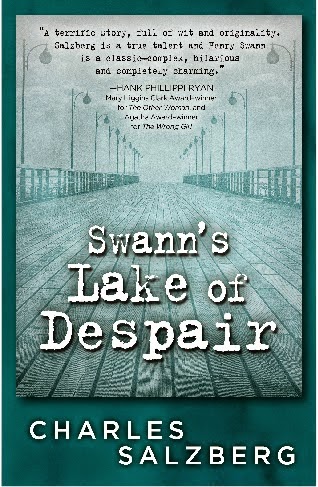
In the third in the series, Swann’s Lake of Despair, I set myself another challenge. I would have Swann investigate three separate cases at the same time, each unrelated to the other, none of them involving murder.
Why? Because to me murder is overrated. On TV each week the viewer is assaulted with perhaps twenty to thirty murders—and in a show like The Following, there can be that many murders in a single episode. But in real life, how many of us are actually affected by murder? Sure, we read about them in the newspapers and hear about them on the television news, but for the most part, it’s not our reality. On the other hand most of experience or even commit other kinds of crimes every day, sometimes more than one. They might be petty crimes, like stealing supplies from where you work. Breaking a loved one’s heart. Cheating on a test. Lying. Misrepresentation. These crimes might not be punishable by a stint in prison, but they are crimes nonetheless. And they can be very personal crimes: crimes that might hurt us deeply.
These are the kinds of crimes I’m more interested in writing about and these are the crimes Swann is called on to solve.
Thinking back, I realize I was profoundly influenced by a 1960s television series called The Naked City. What would be called a police procedural today, there was, of course, a crime committed every week. But often these crimes did not involve murder. Instead, the show, which had “eight million” stories from which to draw, focused on character, deceit, unhappiness; on broken hearts as much as broken heads.
This is what I tried to capture in Swann’s Lake of Despair. In one case Swann is hired by a distraught fellow whose girlfriend has disappeared. His heart is broken, he feels betrayed. In another, Swann seeks to find a lost journal that might shed light on an eighty-year old death that might or might not have been murder or suicide. In the third, he’s hired to find a portfolio of lost photographs by a long since deceased photojournalist. The latter was inspired by a friend and former student of mine, Julia Scully, a wonderful writer whose second memoir in progress (her first was called Outside Passage and was published to wide acclaim), told about her life as an editor in the world of photography in the 1950s and ‘60s. Julia allowed me to ransack her life for this plotline.
And so, if you’re looking for dead bodies, you probably won’t find them in my Swann books. But then again, I love to break rules, even my own, and if it just “happens” organically in the plot, well, you never know, blood might just flow someday.
© 2014 Charles Salzberg
Showing posts with label Swann's Last Song. Show all posts
Tuesday, October 14, 2014
Wednesday, November 6, 2013
How I Stumbled Into Crime Writing and Why I Stuck Around
Meet Charles Salzberg, a wonderful writer and an eloquent champion of fine writing and writers. Charles is the author of the Shamus Award nominated Swann's Last Song, and the sequel, Swann Dives In. His latest novel is Devil in the Hole, based on a 40-year old true crime. The third in the Swann series, Swann's Lake of Despair, will be published next fall. He also teaches writing at the Writer's Voice and the New York Writers Workshop, where he is a Founding Member.
I once heard Charles describe why he prefers pantsing to outlining. Until then, I always thought I should be outlining carefully alla Agatha and my heroine Ann Perry. I just couldn't make myself do it. Every time I tried, my fingers just started typing out the real story instead. Then at the launch of the his second Swann novel, Charles said, "If I already know what's going to happen, I'll get bored." Bingo! I thought. I need to keep myself guessing in order to keep the reader guessing. Now when I get that scary feeling that I don't know where my story is going, I think of Charles's words, take heart, and then surprise myself. Here is the story of how Charles surprised himself by becoming a crime writer.
Annamaria Alfieri
I never meant to
be a crime writer and in fact, I still don’t see myself that way. But I am.
Three novels published with a fourth on the way. All crime.
So yes, I guess I am a crime writer.
As a young wannabe writer I was
partial to authors like Saul Bellow, Phillip Roth, Bernard Malamud, Norman
Mailer, Henry Roth, Djuna Barnes, Margaret Drabble, Fitzgerald, Twain,
Dostoevsky. But writing in that vein,
with a heavy emphasis on character and inner dialogue, although satisfying, was
getting me nowhere. I became too
involved with character and not enough with plot.
And so—I would like to think it was
late one night as I hunched over my typewriter, but I doubt that was the case—I
came up with a plan. I would force
myself to write plot. The best way to do
that, I decided, was to write a detective novel, because there is nothing more
tightly plotted than a good detective tale. I would write a mystery novel that
seemed to be in the tradition of masters of crime, but with a twist. In preparation I gorged on the genre. Everything from Hammett’s The Continental Op
to Charles Willeford’s Hoke Moseley, and Raymond Chandler’s Phillip Marlowe, even
throwing in a little Mickey Spillane and James M. Cain. Once I finished, I knew
what I would do. I’d shake things up a
bit. I’d start with the requisite
missing person, progress to a murder, have the detective follow all the clues
looking for the killer, but in the end, he would not solve the crime. A friend called it “an existential detective
novel.” I liked that.
I
finished that novel, but although praised by agents and editors, no one wanted to
publish it. “You can’t disappoint your
audience. You’re writing a detective
novel, you have to have the detective solve the crime.”
That kind of ruined the point I was
trying to make: that the world isn’t tidy, that things didn’t always add up, that
sometimes chaos rules over reason. So, I tucked it in a drawer—yes, those were
the days when you had an actual manuscript—and moved on to make a living as a
magazine journalist.
Years passed. I got older. And somewhat wiser. I pulled out the manuscript, tinkered with it a little (on a computer, this time), changed the ending, and the book was published. The title, which I loved, didn’t quite make sense anymore—Swann’s Last Song, because the detective is so disillusioned to find that the world is not necessarily knowable and logical that he quits the business—but it was too good to let go.
That was going to be it. I had written what is called a stand-alone. I had no interest in continuing to write crime novels. I would go back to what I loved, writing character driven, literary novels. But to my surprise, the book was nominated for a Shamus Award for Best First PI Novel. I lost. I got ticked off. I’d show them. I’d write another. (Get it: revenge). And so Swann Dives In was born. I had so much fun writing it, that I wrote a third, Swann’s Lake of Despair. In the next two Swann books there are no murders. That would be too easy. There are way too many more interesting crimes to write about.
Wednesday, June 12, 2013
The Sweet Mysteries of Life
Today, I am happy to introduce Charles Salzberg, author of the Swann series of novels about a finder of missing persons. Charles is a freelance writer whose work has appeared in
New York magazine, GQ, Esquire and the New York Times Book Review. He is
the author of Swann's Last Song, nominated for a Shamus Award for Best First PI
Novel, the sequel Swann Dives In, and the upcoming Devil in the Hole. He has
also been a Visiting Professor of Magazine Writing at the S.I. Newhouse School
for Public Communications, and teaches writing at the Writer's Voice and the
New York Writers Workshop, where he is a Founding Member. You can find out more at www.charlessalzberg.com/
Annamaria Alfieri
A few years ago I found myself on a
panel with several other mystery and crime writers, most well-established. I was pretty much a novice, recently having
published my first detective novel, Swann’s Last Song. In a way, I felt like a fraud, since
I had spent a couple decades writing non-fiction books and magazine articles,
while always thinking of myself as a “literary” novelist, whatever that
was. After writing a few novels with
nary a crime in sight, other than the “personal” crimes we commit each day, I
had tried writing a detective novel merely as an exercise, to see if I could
write something where a tightly woven plot was critical.
When it
came time for questions from the audience a woman asked, “what’s the different
between mystery writing and any other kind of writing?” Without thinking, I blurted out, “there is no
difference.” Quickly realizing I had to
back this up, I added, “every good novel is a mystery. If not, why would you bother turning the page
to find out what happens next?”
A couple of
the other panelists nodded in agreement, and then we went on to the next
question. But later, when the panel was
over, I couldn’t help coming back to this question and my answer.
I hadn’t
really considered it before but what I’d said was not only true but essential
for me as a writer. It brought to mind
other questions I and no doubt other writers have been asked over the years,
namely, do I write from an outline and do I know the end of a novel before I get
there?
The answer
to both is, no. For me, an outline would
not only be scary and inhibiting, but also confining. When I write mysteries or in my case
detective novels, I think my plots would suffer terribly if I knew where I was
going.
Especially
in fiction, I think it’s essential to keep the reader guessing. I’m afraid if I know where I’m going, so will
my reader. And so, not only don’t I know
how, where and when my novel will end, but I don’t even know what’s going to
happen on the next page, often even the next sentence. For me, this keeps the writing fresh and if
it’s fresh for me I’m assuming it will be for my reader, as well.
Another way
to accomplish this is to constantly do the unexpected. It’s what I tell my students to do all the
time. When they get to a point where
things seem to be going swimmingly toss in a hand grenade to shake things
up. It’s similar, perhaps, to a plot
twist, but it’s really more than that.
To me, it’s a matter of setting up a roadblock that the character, or
really the author, has to overcome. It’s
like those speed bumps meant to make drivers slow down, and slowing down means
having to think more about what you’re writing.
For
instance, in my last Swann novel, Swann Dives In, in his search for a
missing coed, skip tracer Henry Swann comes across a
beautiful college professor. The
temptation was to have them get together, she seducing him or vice versa. But this seemed stale and predictable to me
and so, with no prior planning, I made her a lesbian. Suddenly, the whole arc of the story changed,
as did their relationship. It made me a
better, more creative writer, because I had to think of my feet. I had to make it work. This is far more like life, which can be
unpredictable, capricious and uncontrollable.
Just when we think we’ve got it whipped, we’re thrown a curve when we’re
looking fastball, and if we don’t adapt we’re done for.
Of course,
there is no right way or wrong way.
Other writers need to know just where they’re going and how to get
there. The two schools of thought are
personified by two talented immensely talented, but very different kinds of
writers. Truman Capote claimed he
couldn’t write the story unless he knew the ending, while Norman Mailer claimed
he couldn’t write the story if he did.
I’m with Mailer. Why would I even
bother writing it if I know how it ends.
The thrill for me is in the discovery of what’s going to happen, how the
characters will act and react. And if
you’ve created “real” characters they will react in real ways, ways that you
don’t have to manufacture.
It’s a cliché that they take on a
life of their own, but it’s true.
And so, each time I approach the
computer there is a sense of dread, but also the excitement of not being quite
sure of what’s going to happen next.
That’s the real mystery.
Charles Salzberg
Subscribe to:
Posts (Atom)


