Showing posts with label Ancestors. Show all posts

Friday, March 27, 2015

The Box of Pictures


In the course of shifting pieces of furniture Harold and I uncovered a cardboard box that we haven't seen in some time marked "Photos." Marvelous things were inside, carefully sorted into different white catalog envelopes labeled "Trips," "Lambertville," "Harold," "Kate" and so forth. the "Kate" envelope held some very old pictures of my grandmother's: one of her father as a young man; one of my mother as a teenager around 1924 posing with Granny and her sister in front of an automobile, with an older man in the front passenger seat; one of Granny and Grandaddy on the steps of their house on St. Croix Street in Saint Stephen, their iconic picture.


I was instantly able to identify the women in the automobile picture. With my keen eye for aging or youthifying people's features, I can generally spot who's who in all these pictures even though I might have known them only as old people. Then there are the houses. Somewhere I have a picture of nearly every house I ever lived in, although not all of them were in the white envelope.

In the envelope I actually found a picture of Mr. and Mrs. Harney's house in Woodbury, where we rented the ground floor during the war. My Dad was an officer in the Navy. I was a seven-year-old delinquent going to school to nuns. How I hated those women. How they hated me. My mother thought that a Catholic school would give me a superior education. Little did she know that the nuns were telling all the kids I was going to Hell for being a Protestant, and I was studying how to be bad so it would be worth it. But that's a story for another day. I loved our landlords, the Harneys, who lived upstairs, especially Mrs. Harney. She had one son but no daughters, and so she used to make a fuss over my sister and me.


The Christmas presents! We opened hers on Christmas Eve. Although we played with them until they fell apart, they will live in my memory forever. The three-inch bride and groom dolls, the groom in a tiny top hat and tails, the bride in white silk, jointed—I can still hear their porcelain joints rattle—would be worth a fortune today. But as Harold says, it's an evil wizard who turns a toy into a collectible.

See the bit of ironwork on the very top of the roof? My friend Deb Snyder and I used to call it a Yawning. To this day I don't know the correct architectural term for Yawnings. It's too small for a widow's walk.


Here's a picture of an enchanted cottage where we spent part of one summer before my sister was born. It was on the water, a cruel rough beach where I cut my big toe on a rock. My mother sat on the lawn and picnicked with the other ladies while Aunt Kay found me a Band-Aid. How I wept.

After blowing up the picture of the car and having a good look at it I realized that I wasn't entirely sure who the third woman was. At first I thought it was Aunt Billie, but in the twenties I think she was fatter than that. It might be Ethel, the eldest. All the sisters looked something like each other. I thought, too, that the man in the car was my great-grandfather Hill, but I'm not sure of that anymore either. Here's what he looked like, holding my mother. He died in 1924.


Then I thought, maybe it's William Moore, my mother's other grandfather, posing in a car with his daughters and granddaughter. But I'm not sure he was still alive in the twenties. I can't find his death date, and there's nobody left to ask. In fact, no one living can identify the old man in the car. Still, perhaps someone in the internet community can tell me about the automobile.

© 2015 Kate Gallison

Friday, January 17, 2014

Divorce Dutch Style


My eighth great grandmother on the Gallison side, one Anneke Adriaens, was divorced in 1664. One seldom heard of such things in those days. But her first husband, Aert Pietersen Tack, was something of a hound and a wastrel. A scholar named Tyler Holman has taken the time to translate a big pile of court papers out of the Dutch so that I might see for myself all the people he owed money to back in New Amsterdam, mostly in beaver pelt equivalents, bushels of wheat, and peas, and all the hired men he cheated out of their pay. Anneke herself was no milktoast. At different times she was brought up on charges for physically attacking one of her neighbors and calling another a whore. The judge always let her off with a stern lecture to stop disturbing the peace.

But one day it came to light that Aert was keeping another wife.

About that time he took off for parts unknown, leaving so many debts that Anneke was forced to sell the farm and all the cows and horses. She turned for comfort to Jacobus Jansen VanEtten, the hired man, my eighth great grandfather. They wanted to be married. She went to court and applied for a divorce. Here's the judgement:

…Anneke Adriaens, his lawful wife, has requested of your honors letters of divorce and permission to marry another person, whereupon, before consenting thereto, the fiscal was ordered on July 31st last to have the aforesaid Aert Pietersen Tack summoned three times by the ringing of the bell to appear in person to hear and to answer, if he can, such complaint and demand as the injured party and the fiscal as her attorney shall make, which summons not only was proclaimed by the beating of the drum in the village of New Haerlem, and whereas nevertheless Aert Pietersen Tack failed to appear and remains contumacious, finding himself unable to defend, justify or purge himself…

(All that beating of drums and ringing of bells failed to cause Aert to appear. Nobody knew where he was. Some said he had gone back to Holland.)

…therefore, the fiscal, nomine offiocii, concludes that the first wife, Anneke Adriaens, must be granted letters of divorce and permission to marry another man, and furthermore that the fiscal and all other officers of justice should be authorized to arrest the defendant, Aert Pietersen Tack, and to confine him here in a proper place of detention, to be taken to the place where it is customary to execute justice, in order to be severely flogged with rods, having two distaffs above his head, and further to be branded with two marks on his back and to be banished from this province. Done at Fort Amsterdam, the 21st of August, 1664.

How do you like them apples? Severely flogged with rods. Branded with marks on his back. Needless to say, Aert declined to turn up and accept his Dutch divorce, preferring to stay in the old country with his new wife. He was never seen again in New Amsterdam. But, I don't know, there's something oddly satisfying about the old Dutch way of doing things. Forget your restraining orders. Forget your alimony awards. Forget your custody agreements. Just keep those flogging rods ready, keep those branding irons hot. That's a divorce a woman could live with.

©  2014 Kate Gallison

Friday, November 8, 2013

How People Used to Live

Still poking among the ancestors. Now, however, I've worked around to the folks who were here within living memory (mine). As you might expect of any storyteller, my immediate forebears were storytellers, too. So I've heard many of the family stories over the years. These tales are of interest to my cousins, and maybe also to you. I feel that we are an extraordinary race. Your family is, too. There are, after all, no dull people, only forgetful relatives.


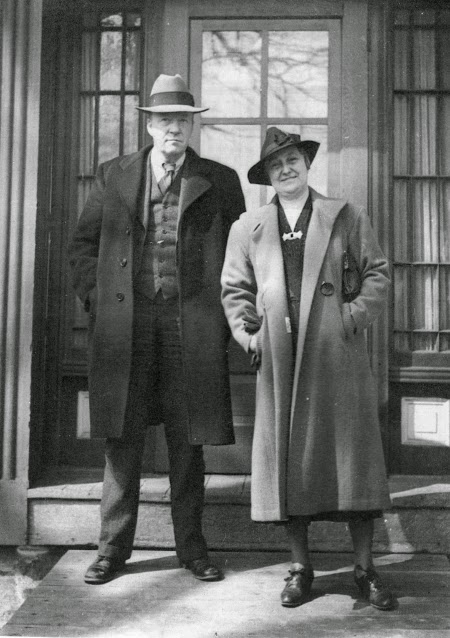
So we remember each other. There are family members whose titanic personalities cause them to stick out above the rest of the tribe like the faces on Mount Rushmore. My father's mother, for one, known to all as Ma Gallison, who used to run the family store in Vanceboro, Maine, without a bank account. She took the train to Bangor to settle the accounts with the wholesalers in cash. Ma ran the family as well as the store; she was feared. Her father, George W. Eales, Sr., was another towering figure. He joined the British navy at the age of ten, in 1825, and got off a ship in Halifax, Nova Scotia, at the age of thirty, declaring that he was now a farmer. Thanks to various cousins I have pictures of him. He was clearly a seaman, even when he was old. That jacket looks to me like original purser's issue.


He died in 1907. In addition to his widow he left four sons and three daughters, of whom my grandmother was the youngest. His sons had daughters who were friends with my grandmother. All these women remained close their whole lives long, helping each other in time of need. I used to hear their names all the time, but since most of them married, their names were all different. I never understood exactly how we were related until last week, when I sat down with Ancestry.com and mended the Eales branch of the family tree.


Two of those cousins or aunts or whoever were expected to come and take care of little Bobbie, Aunt Mildred's boy, so that Mildred could pursue her career with the Bureau of Immigration and Ma could work in the store. One would come for six months, then send a letter to the other one, who would come and relieve her. I heard this story from my father, but I can't remember which aunts or cousins were involved. Anyway the one who was on duty gave my dad the letter asking to be relieved, and he put it in the pocket of his band uniform, which was hung in the closet and forgotten, band season being over. When the second woman failed to show up for duty it caused much ill feeling and many hard words.


You're thinking, why did they do that? Why didn't they hire an au pair, or send the kid to day care? It wasn't done. First of all Vanceboro practically ran on a barter economy, especially during the Great Depression, when Bobby was small. Secondly, the tradition was to take care of one's own. My great grandmother, George Eales's wife, prepared corpses for burial, my father told me. She was the one who did that in Vanceboro, washed the bodies and so on. You didn't pay a funeral director to do that. You didn't pay for help when someone was sick in the house, either. You summoned a cousin. When my mother was operated on for breast cancer in 1948, Cousin Mae Glew came all the way from Vanceboro to Crystal Lake, Illinois, to take care of us while she recovered. The loveliest woman. She used to make us cinnamon buns, all hot and buttery. They would be waiting when we came home from school.

And needless to say you never stayed at a hotel when there was a cousin within fifty miles. Our house in North Plainfield, New Jersey, was on the road to Florida for some of the cousins. I remember a number of merry visits. If we didn't have enough beds we doubled up. Good times.

Now and then I think about the old Vanceboro days when I hear people talk about the American Way of Life. What way is that, exactly?

© 2013 Kate Gallison

Friday, October 25, 2013

And Madly Play With my Forefathers' Bones


What is it about the ancestor thing that people find so seductive?

When I was a snotty teenager and still knew everything, I would have said that people who make a big deal out of their ancestors do it because they have no accomplishments of their own to gloat over. Now that I'm in my golden years, more or less, it seems to me that people who look deeply into their family trees are doing what most of us do all the time, which is to try to make sense out of the world we're in and try to find their own connection to it. Looking backward is one way of doing this.

As I've probably told you, I took out an international membership in Ancestry.com a few months ago in order to track down the Canadians. That's everybody, actually. A hundred and fifty years ago every one of my then living forebears was in Canada. Ancestry.com is a good place to start looking for people back that far, after you talk to your relatives and get some names and places, because they have searchable census records all the way up to 1940 for the U.S. and Canada. I find it easier to sit in my office with a cup of coffee at my elbow than to visit foreign churches for their records and go wading through tick-infested graveyards, the way serious genealogists do. Instead I sit here and collect pretty stories.

The census records are fascinating. They will show you the records themselves, written in the (sometimes nearly illegible) hand of the very census taker who stood on the doorstep and talked to your great-great-grandfather in Dumfries, New Brunswick, Canada, with all your little collateral relations peeking around his knees. It is startling to note that the old boy changed the way he spelled his name every ten years, as well as his country of origin. Welsh? Irish? Makes you wonder.

For the stories of the famous, I have to search the wide internet and read books rather than take on faith anything I get from Ancestry.com. People on my mother's side were famous. You know about the witch, right? Not a witch, a sweet old lady caught up in the unpleasantness in Salem. There were other famous people in that line. My mother's father's folks settled Massachusetts and Rhode Island in the days when everybody had ten or more children, so I have all these distant cousins keeping their names alive. Major Samuel Eelles. I understand there's a whole society of his descendants, with regular meetings and everything. I could join, I guess. What is he famous for? He is said to have assisted in the escape from England of two of the regicide judges who signed the warrant to chop off the head of King Charles I, when Charles II came to power.

Was that a good deed or a bad deed? Depends which side you're on. Passions ran very high in those days. And speaking of judging people, one of the things I've encountered on Ancestry.com comes from some distant cousin in Texas who insists on branding every person who went to Cornwallis, Nova Scotia, in 1760 with a big label: "NOT A PATRIOT." That's because they resettled themselves before 1776, I guess, and so balked this person's desire to become a Son of the American Revolution. But how can he say they weren't patriots? They might have been Canadian patriots. I wonder if this guy is part of the movement for Texan secession. That makes him not a patriot, either.

And so it goes. Am I any more comfortable in my skin for having discovered who I inherited it from? Couldn't say. I have found out, however, that I'm not necessarily descended from the Viking kings of Denmark, which is too bad, since I greatly enjoyed my fleeting association with them. I'll keep you posted if I find any more good stories.

© 2013 Kate Gallison