Showing posts with label Genealogy. Show all posts

Friday, March 27, 2015

The Box of Pictures


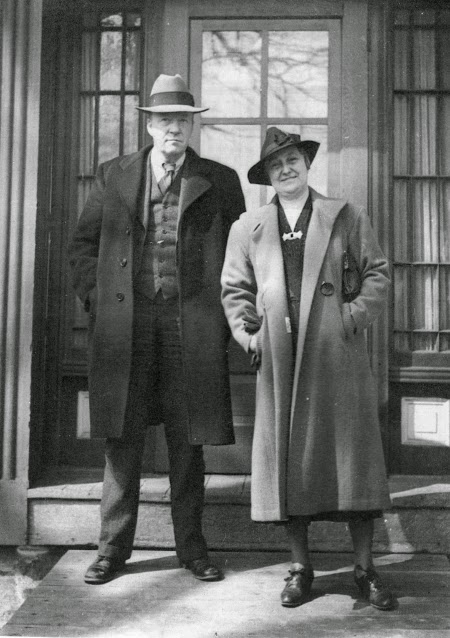
In the course of shifting pieces of furniture Harold and I uncovered a cardboard box that we haven't seen in some time marked "Photos." Marvelous things were inside, carefully sorted into different white catalog envelopes labeled "Trips," "Lambertville," "Harold," "Kate" and so forth. the "Kate" envelope held some very old pictures of my grandmother's: one of her father as a young man; one of my mother as a teenager around 1924 posing with Granny and her sister in front of an automobile, with an older man in the front passenger seat; one of Granny and Grandaddy on the steps of their house on St. Croix Street in Saint Stephen, their iconic picture.


I was instantly able to identify the women in the automobile picture. With my keen eye for aging or youthifying people's features, I can generally spot who's who in all these pictures even though I might have known them only as old people. Then there are the houses. Somewhere I have a picture of nearly every house I ever lived in, although not all of them were in the white envelope.

In the envelope I actually found a picture of Mr. and Mrs. Harney's house in Woodbury, where we rented the ground floor during the war. My Dad was an officer in the Navy. I was a seven-year-old delinquent going to school to nuns. How I hated those women. How they hated me. My mother thought that a Catholic school would give me a superior education. Little did she know that the nuns were telling all the kids I was going to Hell for being a Protestant, and I was studying how to be bad so it would be worth it. But that's a story for another day. I loved our landlords, the Harneys, who lived upstairs, especially Mrs. Harney. She had one son but no daughters, and so she used to make a fuss over my sister and me.


The Christmas presents! We opened hers on Christmas Eve. Although we played with them until they fell apart, they will live in my memory forever. The three-inch bride and groom dolls, the groom in a tiny top hat and tails, the bride in white silk, jointed—I can still hear their porcelain joints rattle—would be worth a fortune today. But as Harold says, it's an evil wizard who turns a toy into a collectible.

See the bit of ironwork on the very top of the roof? My friend Deb Snyder and I used to call it a Yawning. To this day I don't know the correct architectural term for Yawnings. It's too small for a widow's walk.


Here's a picture of an enchanted cottage where we spent part of one summer before my sister was born. It was on the water, a cruel rough beach where I cut my big toe on a rock. My mother sat on the lawn and picnicked with the other ladies while Aunt Kay found me a Band-Aid. How I wept.

After blowing up the picture of the car and having a good look at it I realized that I wasn't entirely sure who the third woman was. At first I thought it was Aunt Billie, but in the twenties I think she was fatter than that. It might be Ethel, the eldest. All the sisters looked something like each other. I thought, too, that the man in the car was my great-grandfather Hill, but I'm not sure of that anymore either. Here's what he looked like, holding my mother. He died in 1924.


Then I thought, maybe it's William Moore, my mother's other grandfather, posing in a car with his daughters and granddaughter. But I'm not sure he was still alive in the twenties. I can't find his death date, and there's nobody left to ask. In fact, no one living can identify the old man in the car. Still, perhaps someone in the internet community can tell me about the automobile.

© 2015 Kate Gallison

Friday, October 25, 2013

And Madly Play With my Forefathers' Bones


What is it about the ancestor thing that people find so seductive?

When I was a snotty teenager and still knew everything, I would have said that people who make a big deal out of their ancestors do it because they have no accomplishments of their own to gloat over. Now that I'm in my golden years, more or less, it seems to me that people who look deeply into their family trees are doing what most of us do all the time, which is to try to make sense out of the world we're in and try to find their own connection to it. Looking backward is one way of doing this.

As I've probably told you, I took out an international membership in Ancestry.com a few months ago in order to track down the Canadians. That's everybody, actually. A hundred and fifty years ago every one of my then living forebears was in Canada. Ancestry.com is a good place to start looking for people back that far, after you talk to your relatives and get some names and places, because they have searchable census records all the way up to 1940 for the U.S. and Canada. I find it easier to sit in my office with a cup of coffee at my elbow than to visit foreign churches for their records and go wading through tick-infested graveyards, the way serious genealogists do. Instead I sit here and collect pretty stories.

The census records are fascinating. They will show you the records themselves, written in the (sometimes nearly illegible) hand of the very census taker who stood on the doorstep and talked to your great-great-grandfather in Dumfries, New Brunswick, Canada, with all your little collateral relations peeking around his knees. It is startling to note that the old boy changed the way he spelled his name every ten years, as well as his country of origin. Welsh? Irish? Makes you wonder.

For the stories of the famous, I have to search the wide internet and read books rather than take on faith anything I get from Ancestry.com. People on my mother's side were famous. You know about the witch, right? Not a witch, a sweet old lady caught up in the unpleasantness in Salem. There were other famous people in that line. My mother's father's folks settled Massachusetts and Rhode Island in the days when everybody had ten or more children, so I have all these distant cousins keeping their names alive. Major Samuel Eelles. I understand there's a whole society of his descendants, with regular meetings and everything. I could join, I guess. What is he famous for? He is said to have assisted in the escape from England of two of the regicide judges who signed the warrant to chop off the head of King Charles I, when Charles II came to power.

Was that a good deed or a bad deed? Depends which side you're on. Passions ran very high in those days. And speaking of judging people, one of the things I've encountered on Ancestry.com comes from some distant cousin in Texas who insists on branding every person who went to Cornwallis, Nova Scotia, in 1760 with a big label: "NOT A PATRIOT." That's because they resettled themselves before 1776, I guess, and so balked this person's desire to become a Son of the American Revolution. But how can he say they weren't patriots? They might have been Canadian patriots. I wonder if this guy is part of the movement for Texan secession. That makes him not a patriot, either.

And so it goes. Am I any more comfortable in my skin for having discovered who I inherited it from? Couldn't say. I have found out, however, that I'm not necessarily descended from the Viking kings of Denmark, which is too bad, since I greatly enjoyed my fleeting association with them. I'll keep you posted if I find any more good stories.

© 2013 Kate Gallison


Friday, September 20, 2013

Sorting Out the Dead

For the last week or so I've been deep into Ancestry.com, tracing the ancestors on my mother's side all the way back to the Great Migration, when the Puritans came over and subdued the howling wilderness of Massachusetts. (I can always tell myself that I'll write a book about those times; if I do that I can put the cost of an international membership on my Schedule C and get a tax write-off.) I enjoyed it greatly, finding out things about ancestors I never knew existed. The way to do this is to find out who your distant ancestors were by accessing official records of birth, marriage, death, censuses and the like, and then go off into the rest of the internet and look up other things about them and their times that might be available.

There's lots of stuff online about the early settlers of Massachusetts. They had a really hard time, and those who found a way to survive are to be commended. All these women had eight or ten children, if they didn't die having the first one, and then they had to find food for them, put clothes on them, and keep a roof over their little heads while they grew big and strong enough to become useful farm workers. I was all set to write a piece about immigrants as a result of these researches, drawing parallels between that crowd, the crowds who came later, and the crowds arriving now. Their struggles are surely comparable. But while I was off playing with my mother's ancestors someone or something got into my tree and messed up my father's side of the family.

The trouble arose mostly because my great grandfather Gallison married two women named Phoebe, Phoebe Mills and Phoebe Howland. The census takers, both Canadian and American, made no distinctions as to maiden names. I know I got their children all sorted out a month or so ago, but somehow it's all messed up again. I mean, seriously. Phoebe Mills had five children before she was nine years old, and then two posthumously? I don't think so. Now instead of writing a nice think piece about all of our hard-working forbears I have to go sort out the Gallisons. Yes. Urgently. Because I'm too worked up about it to think, first of all, and secondly because I have to fix this or I won't sleep tonight. Phoebe Mills died giving birth to Uncle Israel! Everybody knows that! Grrr.

I don't understand how anybody could even get into my tree and change it. I'm going to have to speak to the people at Ancestry.com.

Grumpily yours,

Kate Gallison

Friday, September 13, 2013

Recovering a Family Treasure


In her old house on St. Croix Street in St. Stephen, New Brunswick, my beloved grandmother Hill had a locked closet. Inside were her treasures, things that she knew other people would steal the minute they had a chance; her diamonds; her gold beads; her copy of THE ANNALS.

When Granny became too old to live by herself my mother, her only child, helped her pack up and deal with her possessions and move to Mrs. Lister's boarding house, sometime in the nineteen-fifties. I was too young to be involved in this, but as it turned out I was the only one who knew the true value of a lot of the stuff in that house, or at least its value to my grandmother and the family generally. The kitchen table, for example, was made from a solid piece of golden oak pulled out of an old French well at a military camp in Canada where Grandaddy was stationed. To my mother it was just a table. Granny had never told her the story. So it's gone.

(Don't even get me started on the collection of comic books I had carefully amassed over many summers. That was in my closet in Granny's house, along with the red silk kimono with the gold dragon embroidered on the back and Aunt Ethel's lavender chiffon tea gown.)

I suppose the jewelry was duly gathered up, but the closet of sacred things was left open long enough for whoever was creeping around in search of it to snag THE ANNALS. (It strikes me that this was possibly my great-aunt Mary.) In any case Granny's copy of THE ANNALS was gone for good, never to be seen again.

The annals of what, you ask? Why, The Annals of Calais, Maine, and St. Stephen, New Brunswick, by the Reverend Isaac Case Knowlton, Calais, Maine, 1875.

This book was a trove of genealogical information as well as a—what can I call it?—a sort of class totem, whose mere physical possession admitted one into the upper echelons of St. Stephen society. Without THE ANNALS the young people might forget how the Hills, along with the Markses, the McAllisters, and the others, had settled St. Stephen and turned the wild forest into a place of grace and beauty. The print run was limited, and only the best families had a copy. Not that it was read every night at the dinner table, like the family Bible, but that it was written out in official print for everyone to see. We were the superior people. All the rest of you were ordinary. Knowing this fostered good table manners and gracious behavior.

Now all the Hills have died or left St. Stephen. The young people have forgotten them, even the descendants of the founders themselves. No one has good table manners anymore. No one behaves graciously, least of all me. But people on both sides of the border are interested in genealogy again, as am I. As a result, I was able yesterday to find two digital copies of THE ANNALS online, one put up by Google Books and the other on a Canadian genealogical site.

Paradise. Even better, the University of Toronto is offering a paperback copy at a reasonable price. I'm going to buy it and put it in the plastic tub where I keep the family tree material for future generations. Perhaps it will induce them to get their elbows off the table and stop eating with their fingers. But first I'm going to read it. What style. Here's Knowlton's description of how the dread Passamaquoddy winter came down on the unsuspecting heads of the French settlers on Dochet's Island:

"Fierce winds arose and wrenched the faded leaves from the frightened trees. The air grew sharp and cutting. The birds vanished, fled to their southern homes. The snow sifted down from its exhaustless storehouse, and wrapped the dead and frozen earth in its white shroud. Great blocks of ice were piled on the shore, or hurried by in the black angry water."

Ah. Fine writing.

Kate Gallison

Friday, March 1, 2013

Digging Up the Ancestors

1885: Dedicating the Rebecca Nurse Memorial
I got a call from a previously unknown second cousin on the Gallison side the other day requesting information about my dad's forebears. I couldn't help her very much. I have a lot more information about my mother's side of the family than my father's side, because they paid attention to that stuff. I'm sure I told you about Rebecca Nurse, my 9th great-grandmother, who was dragged out of her sickbed and convicted of being a witch on the say-so of those wretched little girls. Rebecca Nurse had many children, and they all had many children, and so there are a lot of us descended from her. But Rebecca Nurse is neither here nor there a far as the Gallisons go. No relation. Anyway nobody seems to know who the Gallisons really were.

My dad, who never let the truth stand in the way of a good story, used to tell us they were descended from the inventor of the Guillotine. We all knew that was a bald-faced lie. But the other family traditions–that I had a great-great grandmother named Marie LaChance, that the earliest known Gallison was named David–even that he was named Gallison–these were all false as well. I discovered the true facts by signing up for Ancestry.com for an international membership in order to access the Canadian census records, spurred on by the questions my newfound cousin raised. None of that crowd called themselves Gallison until they crossed the border into Maine and settled in Vanceboro.

In the old country, which is to say Canada, they called themselves Galishan, and told the census taker they were Welsh, even though my grandfather was christened with a French name. That is, I guess he was christened. They also told the Canadian census taker they were Baptists, but I feel their hearts weren't in it; I think they were "Home Baptists." There was no Marie LaChance. Thomas Alexander Galishan's father was called William, not David. In Vanceboro they told the census taker they all came from Ireland. I'm beginning to suspect they were crypto-French, maybe going clear back to the days when the British were deporting all the French people in Acadia to the swamps of Louisiana. Hey, I could have been a Cajun, if my forebears weren't so good at hiding out.

Or not. Fact is, the Galishans are lost in the mists of history, at least for now. It doesn't help that they were perfectly willing to tell tall tales to the census takers.

But the ancestors on the other side, the ones who settled Maine, Massachusetts and Rhode Island, are well known and have been closely examined by scholars, genealogists, and descendants who wanted to get into the Sons and Daughters of the Revolution. Next week I'll tell you some of the things I found out about them. Their lives were much harder than mine, poor things, and a good half of them were barking mad. Bordens. Yes. I am a blood relative of Lizzie.

Kate Gallison