Monday, August 8, 2011

The Reason I’m Napping Instead Of Working Today…

Sleeping Woman – Edouard Vuillard

This morning I reached in the cupboard for
a coffee mug and knocked a box of cereal
off the top of the refrigerator
which struck the bridge of my nose
causing a small laceration,
and now, whenever I put on my glasses
they irritate my nose,
so I can’t wear them,
and without glasses,
I can’t work,
so…
ZZZZZZZzzzzzzzzzzzzzzzzzzzzzzzzz

Robin Hathaway

Sunday, August 7, 2011

The Loss of a Pet

by Thelma Jacqueline Straw


On August 9 it will be just one year since I sent my best little friend into that vast realm beyond recall. From which there is no tangible return.

It has been an eternity . . .

I'm a great believer in the nudging of what some people call Divine Providence. When I first thought about writing this for the year's remembrance of the death of Miss Priss, I was afraid readers would see it as too sentimental.

Suddenly on my screen appeared the moving piece by Bob Sullivan of MSNBC , on the recent death of his beloved golden retriever. Lucky died of an enlarged heart June 11, 2011.

I had my answer. Knew I could share Bob's and my thoughts about the passing of a cherished animal companion.

Bob's words:
"No one, nowhere, will ever love me like Lucky did."
"This kind of loss leaves you searching for answers..."
"There is just something about losing a dog, and either you know about it, or you don't."
"Another fellow will just wander up to your campfire when the time is right."
(Bob Sullivan/msnbc.com Bob Sullivan Blogroll)

The death of a beloved pet ranks right up there with the death of a loved human - a parent, a spouse, a child.

But there is a difference. There is a unique bond between a human and an animal. The unconditional love, the total dependence, complete forgiveness. People often write this about dogs, but no dog is closer than a precious feline companion.

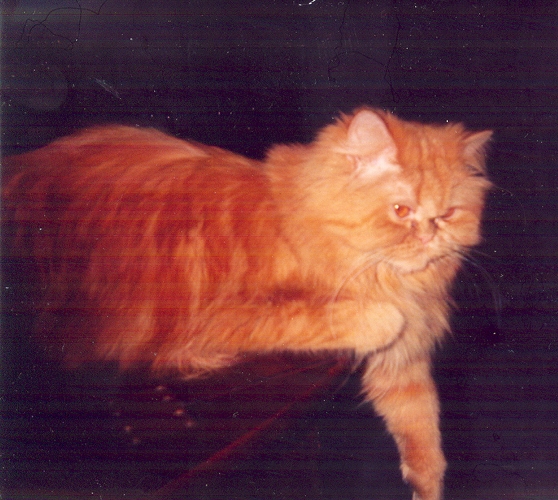
I'd had cats all my life. About fifteen years ago my red Persian Paddy died and I looked all over the Tri-state area for another red Persian. But it was not kitten-time.

Finally, late one rainy day, I found one - at a run-down pet shop that had seen better days, on 2nd Avenue near Grand Central Station.

A tiny, bedraggled kitten peered at me from a filthy cage. She didn't make a sound - but my inner ear heard her beg.

She was a Persian and she was the color of copper and red-gold.

From the very first trip home she never talked. She made her wants known by swishing her gorgeous plumed tail. Or by staring me down with round, soulful eyes.

It was destined that her name would become Miss Priss.

Her sense of play and fun was unique - she delighted in racing down the length of the living room on her hind legs - laughing the whole way.( Noone ever saw her do this but me!)

She had a perfect sense of time. When Daylight Saving changed the clocks, her inner timetable remained the same - to the minute. She would appear silently, wherever I happened to be, and wait patiently until I jumped up to do her bidding!

She loved to go out in the neighborhood for rides in my grocery cart. And how she loved the frequent meetings and gatherings held in her home. My guests were her guests - the buzz of conversation was hers. She was The Hostess!

The only time I ever heard her yowl in all those years was the night I kept her from the party: On November 11, 2009, we threw a party in honor of Bob Knightly's new novel. Fearing Miss Priss might get out of the apartment, I shut her up in her carrier, in a room away from where the action was. After several hours of friendly talk and laughter by old friends of the author, a couple of us heard an unholy howl! The only one in fifteen years!!!

She was used to being the life of the party! She stood her isolation as long as she could - then let it all hang out!

Miss Priss and I were soul-mates. I often looked at her expressive face and thought: Who Are You?

Who Were You Before You Became a Cat?

In the spring of 2010 I knew the winds had shifted. She began to hibernate into her carrier, her special little cave, coming out only to eat a little and use her facilities.

She s-l-o-w-e-d down. Like a wonderful old car that just couldn't run any longer . . .

In the end, she was the delicate weight of a soft feather . . .

Miss Priss, may your special guardian angel always hold you.

And protect you.

Nothing can hurt you now.

You are safe.

And free.


May you rest in eternal peace, my beloved little friend . . .

Friday, August 5, 2011

We're Going to Learn to Live Without Money Now

I was around back in the old hippie days, folks, when young couples voluntarily embraced poverty to move into the woods, cut their own wood, grow and can their own food, and send their kids to school quivering with mortification in clumsily handmade clothing. Worse than that: I used to be married to a newsman, all of us trying to live on his pay, the grownups, the kids, the dog and the cat. I cooked out of a cookbook called Good Recipes for Hard Times. The food described in that excellent book is cheap and tasty, but the food in Julia Child's book, Mastering the Art of French Cooking, is way more impressive. Living with money is better than living without money.

Still, with the politicians' greedy eyes our pensions and the stock market dropping like a shot bird, it's time to drag out the hard-times stuff again and try to live without money. The magazines have always given us handy tips on how to do this, but they were generally compiled by people who had jobs, writing for magazines. Diana Vreeland, as I recall – editor of Vogue, the Anna Wintour of her day – advised us to rinse our hair in flat Champagne. Really, it's pointless to waste it. I envision her sending the maid around after the party to collect all the half-finished glasses and empty them into the hair-rinsing basin. Family Circle and Woman's Day had more practical tips generally, but a lot of their suggestions seemed beside the point to me.

Here are Kate's handy tips on living without money, collected during the lean years:

  1. Become a philosopher. Seriously, you can train yourself not to lust after material objects. Even shoes. You don't have to lust after shoes.
  2. Walk. Okay, for that you need shoes. But they don't have to be expensive shoes. They say walking is the best form of exercise, and you don't need a gym or a trainer. For weight training, do arm curls with soup cans. Concentrate on form.
  3. If you're unsure of the correct form of an arm curl, check out YouTube. I know you already have a computer, or you wouldn't be reading this blog. There are many fitness videos on YouTube, as well as yoga poses and dance instructions, even tap dancing. Yours for free.
  4. Patronize your local public library. They have magazines you can read while sitting in the free air-conditioning. They have movies on DVD and music CDs you can take home. Oh, and books. Lots of books.
  5. Play with your children, if you have any. They don't last, you know. Soon they'll be teenagers and refuse to give you the time of day. Enjoy them while they still like you.
  6. Dress bravely. While it's true that expensive clothes look better than cheap clothes, as a general rule, there are ways to dress well without breaking the bank. For in-depth advice on this matter, The Clothing Chronicles of Diana Pemberton-Sikes can't be beat.
  7. Do not cut your own hair. My hairdresser is Frankie Giordano at The Hair Cuttery in New Hope, PA. He's a genius, and he's not all that expensive. If you're lucky there will be someone sort of like Frankie near where you live.
  8. Never spend a penny you don't have to, but when you have to, do it with a good grace.

I haven't mentioned do-it-yourself auto repair or home improvement skills, although we did these things back in the day, because you can end up costing yourself more than you save. Only you know what you are capable of.

And that's about it. Good luck to you in the coming hard times, and keep smiling. Always remember: We are morally superior to the rich.

Kate Gallison

Wednesday, August 3, 2011

The Thoughts of Youth

I was thirty-one when I wrote the essay I share with you today.

I am a pack rat. I keep stuff, but not the way Aunt Jeanne keeps old newspapers and the lingerie of her young days, seventy years ago. I keep books and essays I wrote years ago that I never did anything with. But when I run out of space in the file drawers, paring down the junk paper is the only choice. In the latest purge, I came across the following essay from my day job as a corporate development expert and management trainer, working in a Wall Street bank. These words pre-date my five books on business subjects. I share them today, verbatim from what was in the file, (that I had typed on a typewriter!). I want them to see the light of day before I destroy them forever. They seem a whole lot more amusing than anything else I can think of to say this week. As you will soon see, what I said turned out not to be true. The ruling class then is pretty much the ruling class now, especially on Wall Street. Nothing has changed in that regard, but here is my wishful, youthful thinking from 1972:

The Coming of the Corporate Ice Age, or Where Have All the Flowers Gone?

For the past nine years, I have observed corporate America from near the bottom of the organization chart. About two years ago, I became consciously aware of making cosmic generalizations about what I saw.

Last year because it was fashionable, I started to call this hobby of mine “corporate anthropology.” Since then, I've gotten into a whole new field which I'm calling “corporate geology,” which isn't really right, because it's not the study of rocks, but of fossils or soon-to-be fossils.

In writing all this down, I have one big problem. I don't know exactly what happened to the dinosaurs. I guess I could go up to the Museum of Natural History and find out what happened to them, but instead I'll begin by expounding my theory of what happened.

There they were in those lush jungles, huge, pea-brained creatures ruling the land by sheer power and size. They were completely committed to the status quo, had spent generations evolving into the kind of animals that were best at living in the jungle. They knew all they had to do was to be consummate consumers of as much vegetation as they could and they would grow even bigger offspring who could take over for them. Since they never had to worry about where their next meal was coming from, they never bothered to learn new skills, and eventually lost their ability to learn any. Then, a nasty thing happened – the environment, which they had dominated by being totally committed to it, changed on them. The ice age came; the jungle disappeared and with it the dinosaurs.

So it is with the corporate dinosaur – the wealthy WASP American Male. It is necessary here to make clear distinctions between the corporate dinosaur and another creature who greatly resembles him. There are wealthy WASP American men working in corporations who are not corporate dinosaurs. They have one basic distinguishing characteristic – the size of their brains and/or their contributions to whatever the company does is roughly commensurate with their status in the organization and /or the amount of green stuff they consume.

The corporate dinosaur, on the other hand, is making it because at least four of the following:


  • A father who is the head of another large corporation
  • A Roman numeral after his name, (or two initials or an initial followed by a middle and last name). This may change depending on the fashion, but he'll always use one or the other.
  • Membership in the right club
  • Good "connections." This means he knows a lot of rich people just like him and is especially helpful in financial corporations, where he can be paid to hang around with them if they do their investing and/or banking through the company.


There he stands, striking just the right confident pose, unaware that behind the potted palm nearby an artist from National Geographic is sketching him so that future peoples will know what he looked like.

This creature's gait is slow; he exhibits poise and calm even during ritual combat. Not so his distant cousin, who lives, during daylight, in great frenzy.

Newly arrived from the immigrant classes, the neo-dinosaur is also white, male, maybe not Anglo-Saxon, probably not Jewish – the truly tragic character on the scene. This species has spent a couple of generations getting into the jungle. Not having evolved there, he has to use wit and cunning to survive and succeed. Smaller than the classic dinosaur (suffering particular disadvantage because of his smaller and more vulnerable pocketbook), the neo-dinosaur has managed to make some gains. But, he's still second on the philo-genetic scale; most of the plants in his part of the jungle are plastic, his consumption rate is lower (although he lives on the illusion that it is rising, that he is catching up). He has set up neo-dinosaur training camps, designed to look as much like the authentic camps as possible, where he sends his offspring (particularly males) to be trained in dinosaur ways. He keeps before him the dream of arriving at the ancestral place of the old-line dinosaur and strives after semblances of movement in that direction, reaching beyond his means to live in more and more expensive clearings in the jungle, far away from the "lower animals". He spends his three weeks’ vacation at the water hole most recently abandoned by the real dinosaur.

The neo-dinosaur's wits are still sharp enough to hear, especially when he gazes at the ice cubes in his bar-car martini, that the glacier's on the move. His response is to be resentful, to hold his ground for his territorial instinct is strong and he has fought hard for his piece of turf. Most of the old line dinosaurs have lost their ability to perceive this change in the jungle.

For both these great beasts, extinction is nigh. Small animals—mammals even—are beginning to adapt and thereby make changes in the environment. The jungle is changing faster and faster. The dinosaurs own heavy consumption rate is destroying the very jungle they depend on. Their offspring are deserting the training camps to go and live on roots and bananas with the lower animals Even the females of their own species are beginning to question the wisdom of traditional dinosaur ways. But as the changes and disappearance of the jungle continue, all we hear from the dinosaurs is the sound of munching and an occasional chorus of, "Where Have All The Flowers Gone."

Annamaria Alfieri

Monday, August 1, 2011

10 Ways to Chill Out

  1. Do nothing
  2. Drink cool beverages
  3. Doze in air-conditioned room
  4. Daydream
  5. Eat ice cream
  6. Read books set in cold places*
  7. Take a cold shower
  8. Don’t wear any clothes
  9. Listen to cool jazz
  10. Think cool thoughts


*10 Cool Books to Beat the Heat:
  1. Call of the Wild – Jack London
  2. Bodies in Winter – Robert Knightly
  3. Snow Falling on Cedars – David Guterson
  4. Winter Solstice – Rosamunde Pilcher
  5. Fear Itself – Elena Santangelo
  6. Italian Shoes – Henning Mankell
  7. The Snows of Kilamanjaro – Ernest Hemingway
  8. Hans Brinker, or the Silver Skates – Mary Mapes Dodge
  9. Steve Hamilton’s Alex McKnight series
  10. Anything by a Russian novelist…

Robin Hathaway